For a long time, we saw black holes as distant, mysterious, and even somewhat predictable entities, at least within the known rules of physics… After all, we knew they could form from massive stars, that they could collide and even emit gravitational waves. But every now and then, the universe decides to remind us that we still don’t fully understand anything… And that’s exactly what happened with a discovery made in late 2023. Yes, we’re talking about an event so powerful, so far beyond the ordinary, that scientists are still trying to understand everything that happened there.
What are black hole mergers?
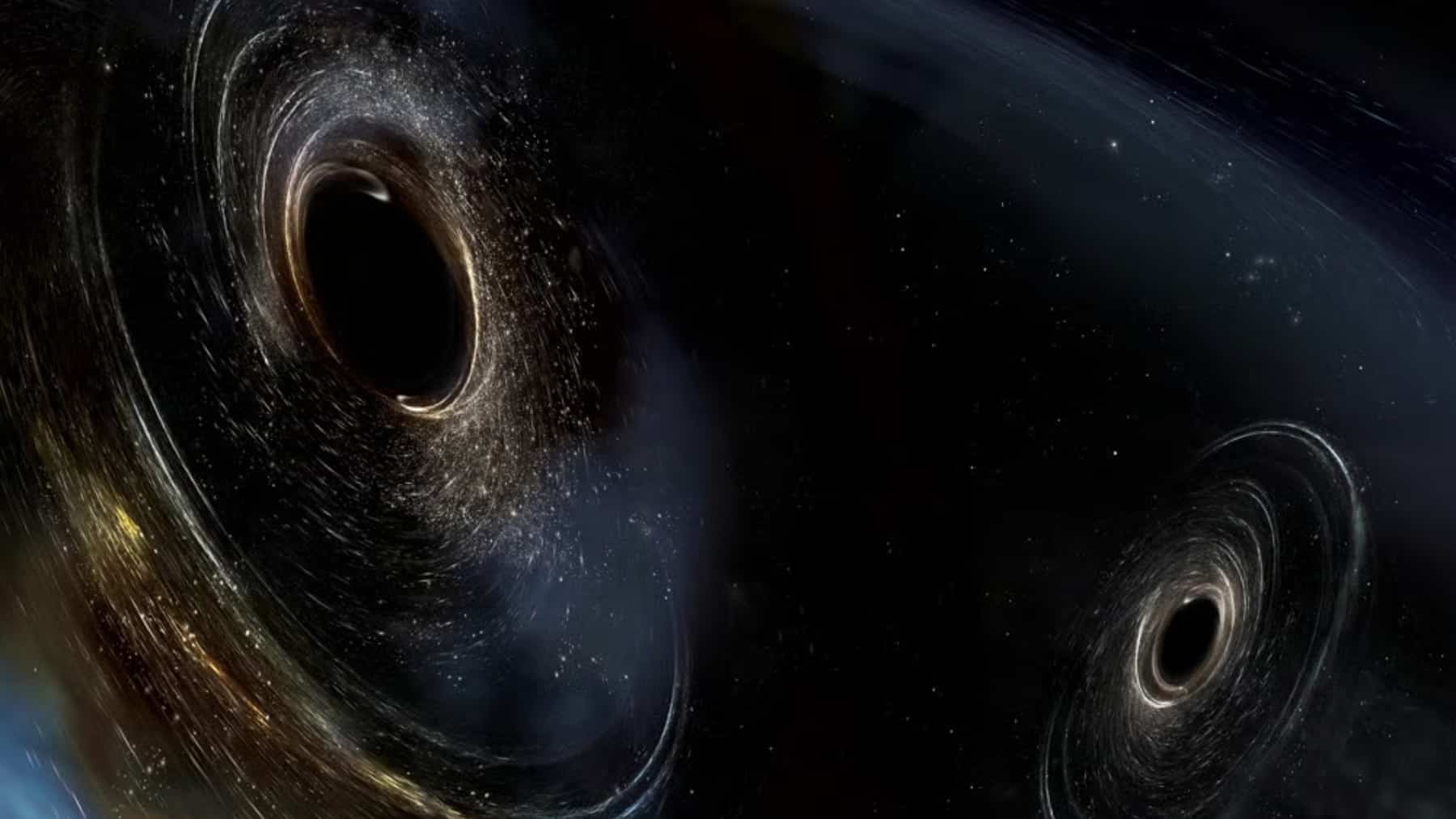
However, before understanding the impact of this new event itself, we need to recall some basic concepts: black holes are not “holes” in space, but rather regions with such intense gravity that nothing, not even light, can escape. And when two of them enter a kind of orbital dance and end up colliding, the merger generates an absurd amount of energy, but this energy comes in the form of gravitational waves, which are tiny distortions in the very fabric of space-time.
These waves travel through the universe like ripples in a swimming pool and can be detected by observatories such as LIGO, Virgo, and KAGRA, which use ultra-high-precision lasers to detect these tiny variations. And they are little, you see? That’s because, when these waves pass through Earth, the distortion is a thousand times smaller than the diameter of a proton. However, even though they are almost imperceptible, these waves carry a tremendous amount of information.
Meet the invisible monster born from an unexpected fusion
Back in November 2023, three observatories detected an event named GW231123. As scientists analyzed the signals, they uncovered something surprisingly different about these black holes:
- One had 100 solar masses.
- The other 140.
And together, they created a new black hole with no less than 225 times the mass of the Sun (that’s almost as surprising as this ‘something’ that’s swallowing stars at an incredible rate). This is the largest black hole ever detected resulting from a merger. To give you an idea, the record previously held by a black hole with 140 solar masses. In other words, this new event not only broke the record, it nearly doubled it. What’s more, these black holes were spinning at incredible speeds, about 400,000 times faster than Earth’s rotation.
“The black holes appear to be spinning very rapidly — near the limit allowed by Einstein’s theory of general relativity. That makes the signal difficult to model and interpret” said Dr. Charlie Hoy, a gravitational-wave astrophysicist.
How to explain this new phenomenon in the Universe?
And here comes the real mystery. Because, theoretically, we shouldn’t be seeing black holes this large. After all, current science says that black holes formed by supernovae rarely exceed 50 solar masses. So two hypotheses are being considered:
- Chain mergers: These giants may have formed from previous mergers in superdense environments like globular clusters, where black holes can frequently occur.
- Primordial stars: We are seeing echoes of the early universe, where the first stars were much larger than today’s, capable of collapsing directly into massive black holes.
Both theories are possible, but neither is simple. The fact is: GW231123 is forcing scientists to rethink everything they know about how black holes form and evolve. And here’s a stunning detail: 15 solar masses were converted into pure energy in the form of gravitational waves, something so colossal that it surpasses the energy of all the stars in the Milky Way over 2,000 years. Yes, that’s why we can never stop analyzing black holes. We did it once, and one of them transformed an entire galaxy.