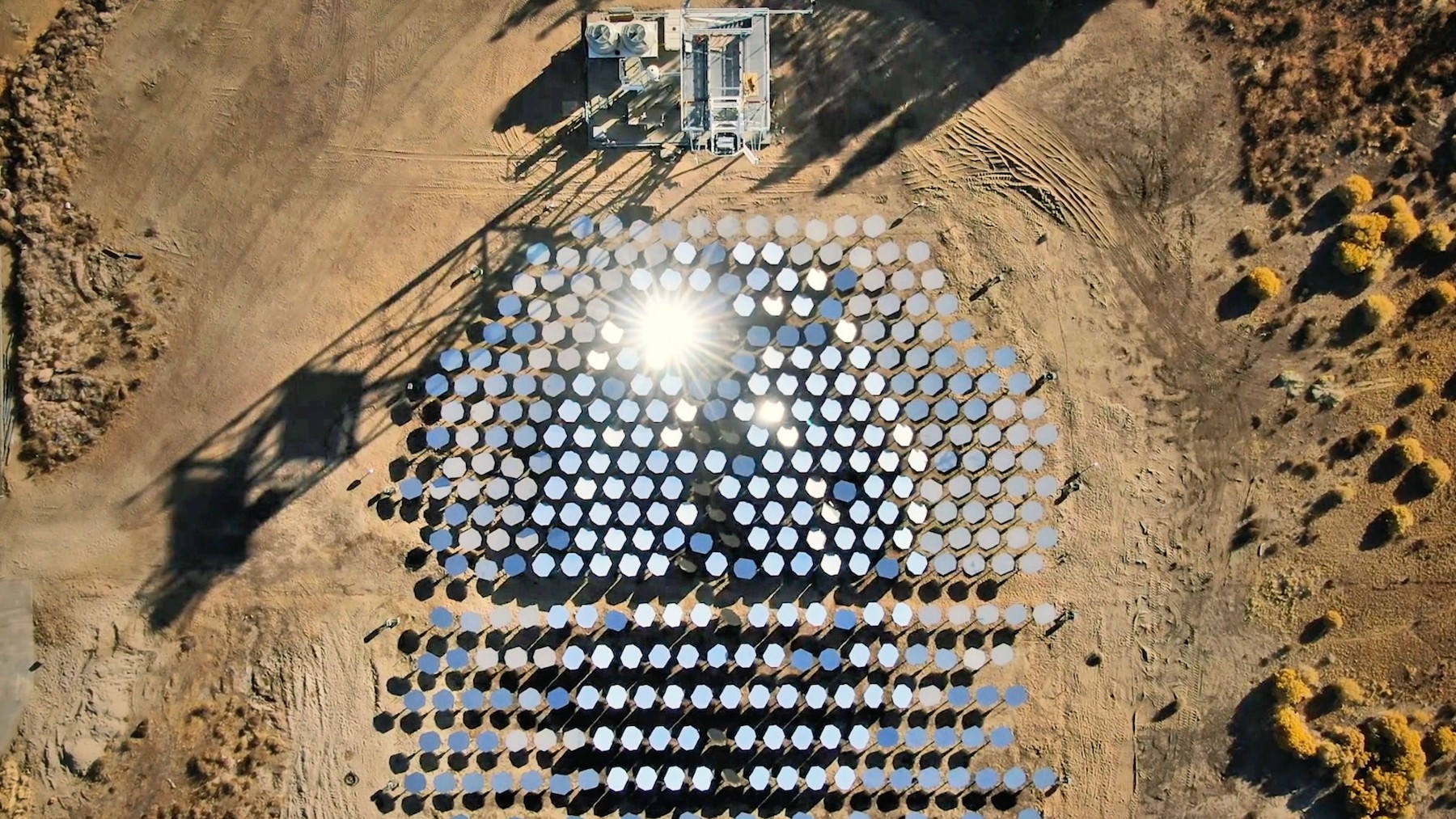
California-based Heliogen has recorded a breakthrough in the renewable energy industry by focusing sunlight at temperatures hotter than 1000ºC and up to 1500ºC. The achievement was made at Heliogen’s pilot plant in Lancaster, California, and puts the young company at the front lines of the shift away from fossil fuel-based power.
Where conventional solar power has endeavored to capture the sun’s rays to produce electric currents, Heliogen harnesses the power of the sun to produce heat. This new type of CST systems has the prospects in the crisis of industries like cement, steel, and petrochemicals requiring fossil energy for high-temperature applications and hence decrease GHG emissions significantly.
A new era in concentrated solar power technology is here
Heliogen has designed a novel concentrated solar thermal system that is incrementally the next-generation discovery in solar power. Unlike ordinary PV solar panels, which depend on photovoltaics to directly generate electricity from the sun, Heliogen has developed its technology to use computer vision software to position an array of power-flaring heliostats in a way that would concentrate the light onto one point.
This precision enables the production of temperatures considerably higher than the existing solar thermal systems, which have been producing temperatures above 1500ºC. This temperature range is significant for industrial applications where high-temperature conventional methods, for instance, in cement and steel manufacturing industries, use extreme heat normally derived from the burning of fossil fuels.
The heliostats are also adaptive, thereby giving Heliogen the incentive to use artificial intelligence to maintain the focus towards the target during the day, thus making it the most efficient and reliable solar power plant.
The potential for hydrogen production and reduced emissions in industry
Perhaps the most attractive aspect of Heliogen’s breakthrough is that it may help replace fossil fuels in industrial applications. Sectors including cement and steel, generating high carbon footprints, contribute a large proportion of the emissions, cement manufacturing contributing over 7% of global emissions. These industries use heat usually produced by burning coal, natural gas, or any other fossil fuel.
These industries require a lot of heat to operate, and with Heliogen’s technology of providing concentrated solar power to create the required heat, these industries can be made significantly less carbon-intensive. In addition, the company has its goal to reach temperatures as high as 1500°C to allow breaking down CO₂ and water to produce fuel sources like hydrogen and syngas.
This renewable hydrogen that requires no fossil fuels is regarded in the energy market as capable of triggering drastic changes if the system used by Heliogen is improved to scale up.
Unlocking environmental benefits and economic opportunities with CSP technology
It has high prospects concerning the improvement of the environment in case the firm deploys the technology of Heliogen. As will be discussed, offering an efficient carbon-free energy fed solution for industries that depend heavily on fossil fuels, the system could help cut greenhouse gas emissions around the globe.
Concrete, steel, and petrochemical industries are some of the biggest culprits in causing climate change, and it hasn’t proved easy to come up with renewable energy sources for such industries. The company’s current system not only solves the problem of high-temperature heat demand but also offers a viable path to scale and potentially be integrated into industrial facilities around the globe.
Moreover, as the cost of power generation from CSP reduces, CSP technology will likely have economies of scale that would enable it to compete effectively with fossil fuels. At the same time, this is the most effective way to store heat making concentrated solar thermal energy attractive for the industrial sector. The lower dependence on scarce metals such as REEs used for battery storage in traditional PV systems also adds to the cost-effectiveness of Heliogen’s solution.
Thus, Heliogen’s concentrated solar thermal systems signal a shift of solar energy from conventional perception. Using sunlight to attain temperatures beyond 1,500ºC has enabled the company to provide a natural substitute for conventional fuel sources for enterprises that need high-temperature applications.
The work also has the additional benefit of decreasing greenhouse gas emissions in the transportation sector by up to 90 percent and making available clean fuels like hydrogen. As more work is done on Heliogen and the control of its technology is enhanced, there is potential to generate environmental and economic impact that is broad. This system might be deemed successful and provide a new milestone in renewable energy where industries that used to depend much on fossil energy sources can switch to using renewable energy sources.