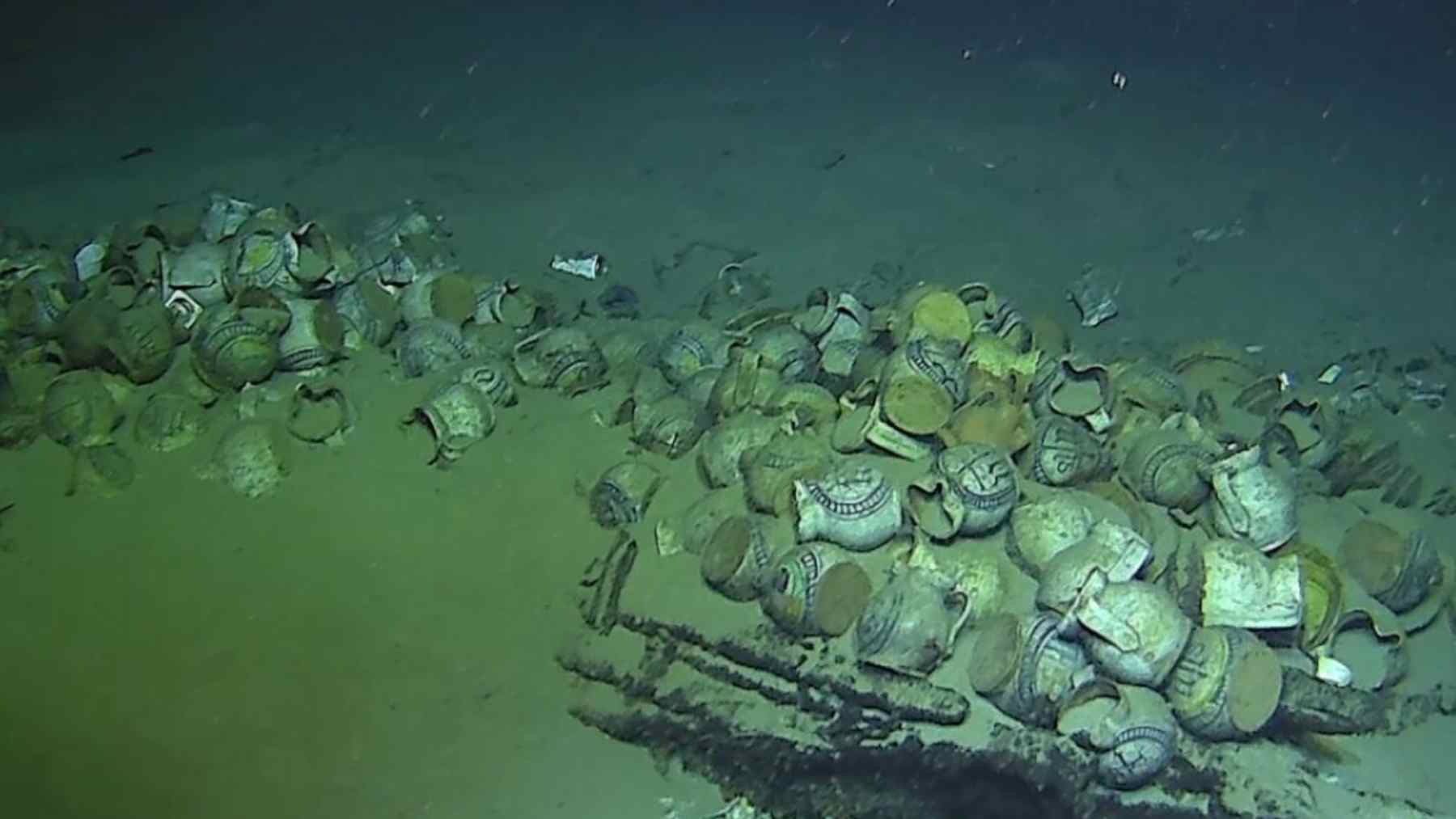
In the deep dark of the Mediterranean, more than 2,500 meters below the waves off southern France, a merchant ship from the 1500s has just reappeared on scientists’ screens. The vessel, now known as “Camarat 4,” lies on the seabed almost intact, surrounded by jugs, plates, and metal bars that look as if they were dropped only yesterday. What story does this silent wreck still have to tell?
This record-breaking shipwreck, uncovered by the French Navy and studied by France’s Department of Underwater and Submarine Archaeological Research (DRASSM), could change what historians know about trade in the Renaissance Mediterranean. Underwater archaeologist Marine Sadania, quoted in French newspaper Le Monde, has already called it a kind of time capsule preserved far from storms and looters on the surface.
A record-breaking find off the coast of France
In early March 2025, a French Navy team was running deep-sea training exercises off the town of Ramatuelle near Saint-Tropez when sonar picked up an unusual shape on the seafloor. The crew sent down a camera on an underwater drone and watched the outline of a 30-meter-long wooden hull appear out of the darkness.
The wreck rests at more than 2,500 meters depth, around 1.6 miles down, making it the deepest shipwreck ever documented in French waters, according to an official announcement from the Mediterranean Maritime Prefecture and the French Culture Ministry. At that depth the water is icy cold, pitch black, and almost motionless, which helps explain why the site looks like a locked vault on the seafloor rather than a pile of scattered scraps.
What scientists found inside “Camarat 4”
When archaeologists reviewed the high-definition footage, they saw piles of decorated ceramic jugs covering the wreck. Many of these nearly two hundred pitchers carry floral and geometric designs or the letters IHS, a traditional Christian monogram for the name of Jesus.
Alongside the jugs sit stacks of yellow-glazed plates and bundles of metal bars, probably iron, that were either cargo or ballast to stabilize the ship. Researchers also noted six cannons, a large anchor, cooking pots, and navigation tools, signs that this was a working merchant vessel traveling along a busy and sometimes dangerous sea lane and likely carrying goods from Ligurian workshops in northern Italy toward markets farther west.
Deep-sea robots and the new face of archaeology
Because no diver can safely reach 2,500 meters, every image from Camarat 4 comes from machines. The wreck was first detected with multibeam sonar during a routine seabed survey, then explored with remotely operated vehicles equipped with cameras, lights, and robotic arms controlled from the surface.
The French team is now planning to create a 3D “digital twin” of the wreck by stitching together thousands of overlapping images while lifting only a small number of objects for study in the lab. In practice, that means future students could explore the site on a screen almost as if they were piloting a robot themselves, a quiet revolution for a field that once depended on divers and sketchbooks.
A time capsule of Renaissance Mediterranean trade
Camarat 4 does not seem to have carried gold or jewels, but its everyday cargo may be even more valuable to historians, as journalist Sarah Kuta notes in a report for Smithsonian Magazine. The jugs and plates point to a ship loaded with finished goods from Italian workshops, probably heading toward ports in France or Spain where families would use these objects in their kitchens and on their tables.
Other famous wrecks in the same region, such as the Lomellina and the Sainte-Dorothéa, showed that the Gulf of Saint-Tropez was a major highway for merchant ships during the 1500s. This new find adds a rare deep-sea piece to that puzzle and reveals in detail what ordinary merchandise looked like for the traders who crisscrossed the Mediterranean at the dawn of the modern age.
Pollution, protection, and the future of the wreck
Amid the five-hundred-year-old ceramics, cameras also recorded something less romantic: plastic bottles, beer cans, fishing nets, even a yogurt pot tangled among the plates. It is sobering to see the same everyday trash that fills beach bins also sitting more than a mile and a half under the sea beside the remains of a Renaissance ship.
For now, authorities say there are no plans for a full excavation, since large-scale digging could damage the site and would be costly and risky at such depth. Instead, research will focus on mapping, targeted sampling, and digital models that can be shared in museums and classrooms so people on land can explore the wreck without disturbing it.
The main official press release on this discovery has been published by the Mediterranean Maritime Prefecture and France’s Ministry of Culture.