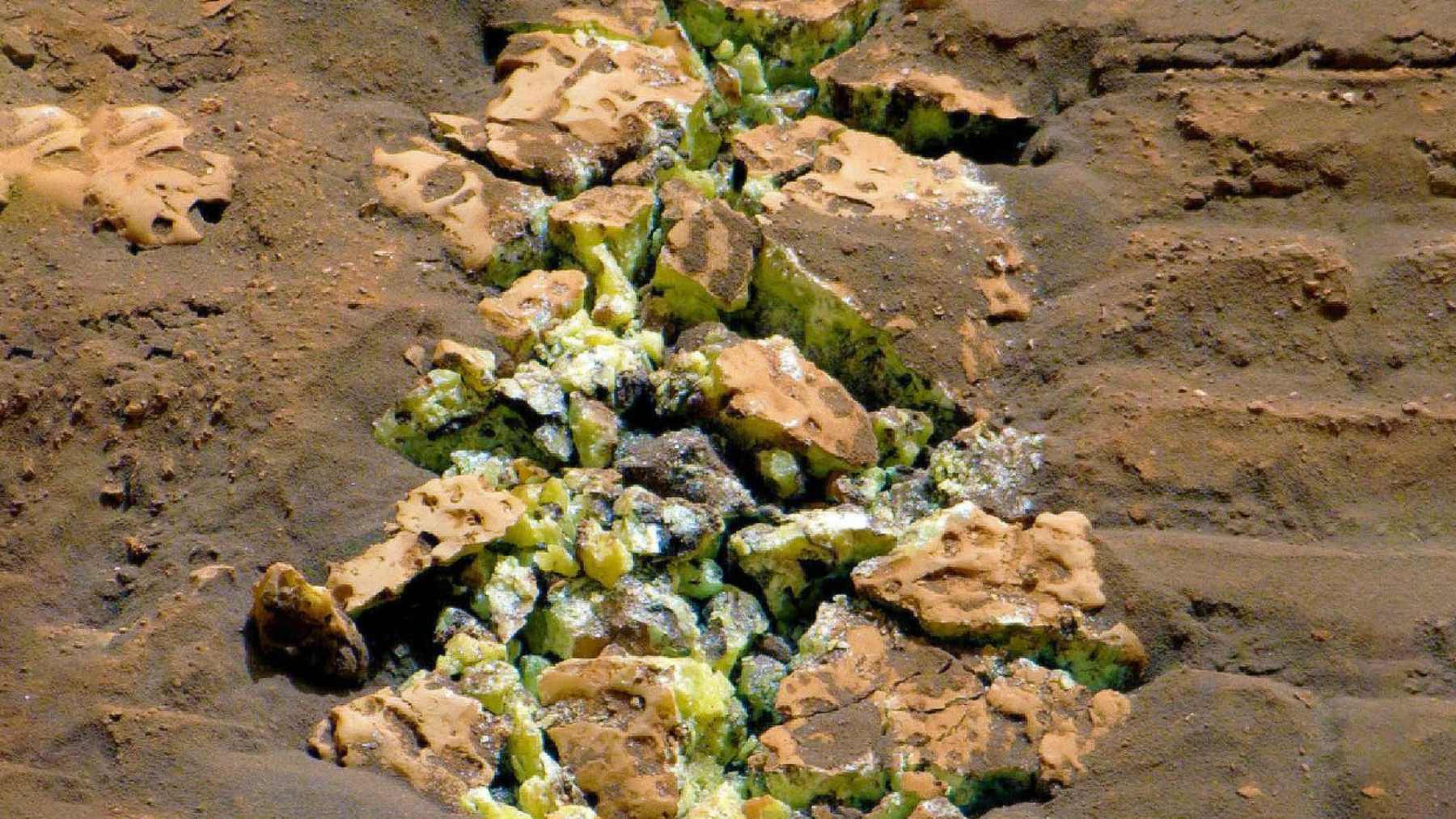
NASA’s Curiosity rover did not set out to make headlines with a “eureka” moment. It simply rolled over a rock on May 30, 2024, cracked it open, and exposed something scientists had never confirmed on Mars before: bright yellow crystals of elemental sulfur, also called “native sulfur.”
That detail matters because Curiosity has found sulfur on Mars many times, but usually locked inside sulfates, salts that form as water evaporates. Pure sulfur is different. It forms under a relatively narrow set of conditions, and NASA’s team says those conditions have not been associated with this specific location’s known history.
Even more surprising, the rover did not find a single odd rock. It found what the mission described as a whole field of light colored stones similar to the one it crushed. Curiosity project scientist Ashwin Vasavada summed up the problem and the excitement in one line: “Finding a field of stones made of pure sulfur is like finding an oasis in the desert.”
Where the sulfur showed up
The discovery happened in Gediz Vallis channel, a winding groove on Mount Sharp inside Gale Crater. Mount Sharp rises about 3 miles or 5 kilometers, and Curiosity has been climbing its layers since 2014, using the mountain like a natural timeline of Mars’ changing environments.
Since October 2023, the rover has been exploring a region “rich with sulfates,” which already signaled a watery past tied to evaporation and shifting chemistry. The new find adds a puzzle piece that does not fit neatly into the story scientists thought they were reading from the rocks.
Gediz Vallis is also a place where the landscape itself looks dramatic. NASA says scientists suspect the channel was carved by flows of liquid water and debris, and Curiosity’s close up work suggests both energetic floods and landslides shaped different debris piles. Becky Williams of the Planetary Science Institute put it plainly: “This was not a quiet period on Mars.”
Why elemental sulfur raises eyebrows
On Earth, sulfur chemistry is deeply tied to geology and biology. Some microbes use sulfur compounds to gain energy, and sulfur often shows up where water, heat, and rock interact.
But it is crucial to keep the logic straight. Finding sulfur, even pure sulfur, is not the same as finding life. What it does provide is a stronger map of what kinds of chemical environments existed, which is the groundwork you need before you can even ask whether microbes could have survived there.
NASA’s own framing is cautious. In a follow up update later in 2024, the agency noted that on Earth pure sulfur is associated with volcanoes and hot springs, and it added that “no evidence exists on Mount Sharp” pointing to either of those causes.
That uncertainty is the point. Elemental sulfur can be produced through several pathways, and different pathways imply very different conditions. Some could be wetter, some could be hotter, some could involve chemical reactions that shuffle sulfur between forms. The next step is narrowing down which scenario actually matches the rocks Curiosity is seeing.
What Curiosity is doing next
Curiosity has been collecting data around the sulfur field and documenting the channel in detail, including wide panoramas. By late 2024, NASA said the rover was preparing to leave Gediz Vallis and begin a months long drive toward a “boxwork” region, a large pattern of ridges that may have formed when minerals carried by groundwater filled fractures and later hardened.
One reason that destination matters is that underground, salty water environments are considered plausible habitats on early Earth. Curiosity scientist Kirsten Siebach described the appeal of the boxwork this way: “These ridges will include minerals that crystallized underground, where it would have been warmer, with salty liquid water flowing through.”
So the sulfur discovery is not the end of a debate. It is a reminder of how Mars exploration actually works. A rover’s “mistake” can expose a new target, and a single mineral can force scientists to rewrite parts of the planet’s chemical history.