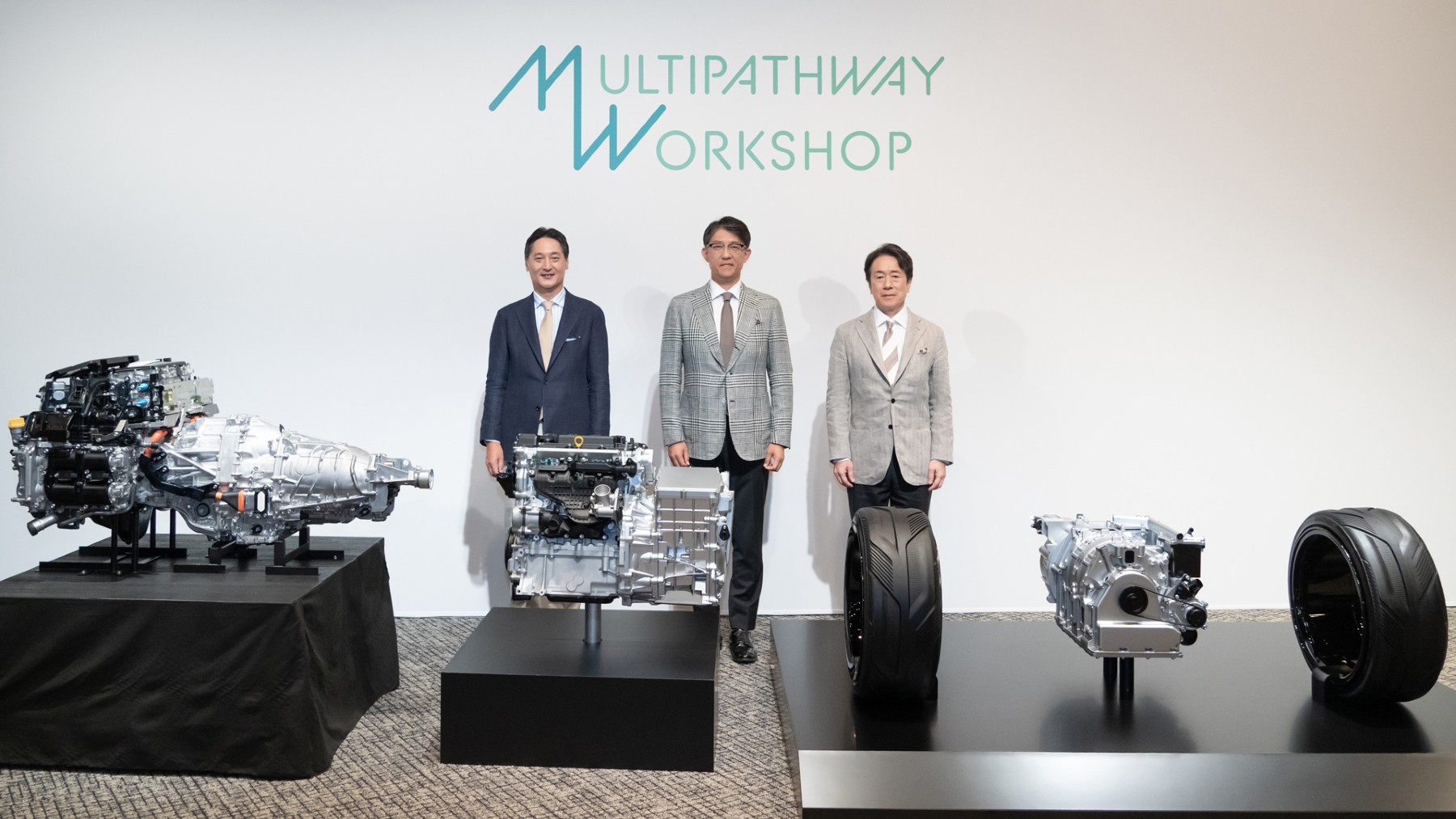
Among all the car manufacturing companies, Toyota Motor Corporation has had great success in the constantly-changing automobile industry as they recently introduced a new generation of compact engines adaptable to various fuels. This groundbreaking development is set to transform the industry and could provide a solution to cut airfares incredibly while bringing the industry a little nearer to a more sustainable future.
Toyota’s alliance with Subaru and Mazda has provided engines of flex-fuel characteristics that can use both gasoline and hydrogen and synthetic fuels to open up the way toward a pluralistic fight against emissions and energy consumption. This research study is a testament to Toyota’s company’s ability to evolve and participate in the shift towards a new energy frontier by playing a part in the effort to make automobiles environmentally friendly.
A compact package, high impact
Thus, Toyota has developed highly compact multi-fuel engines and remarked that their volume and height are reduced by 10-20 % compared to similar engines. Notably, these engines will be smaller in size yet are expected to be more powerful than their larger counterparts while at the same time producing improved fuel efficiency.
This feat has been made possible by inventing sophisticated technologies and engineering to blend electric drive units, motors, and batteries with fuel-injected engines in ways that allow for a smooth transition between different power sources while attaining maximum efficiency. The small size of such engines also presents added design opportunities for automobiles, especially lower hood lines, and possibly more streamlined models, which could lead to greater fuel mileage and improved efficiency.
Incubating today, mainstreaming tomorrow: hydrogen and synthetic fuels
The second use of Toyota’s multi-fuel engine is one of the most thrilling features since people can power it using hydrogen and manufactured fuel. The hydrogen fuel-cell innovation began when Toyota used it in a new model called Mirai, and Toyota’s willingness to use it in the creation of racing cars also shows the company’s allegiance to this green energy source. Also, compatibility with synthetic fuels, or e-fuels, enables a new level of emissions reduction and a scaled or circular economy.
Thus, using these other sources of energy, Toyota is, in essence, not only branching out in terms of energy supply but also creating opportunities for transportation to be divorced from the current stationary source of fossil energy, which has an immensely adverse effect on the earth, hence enabling the company to minimize on its impact on the environment. The development and implementation of building materials must meet the following fundamental considerations to address the thermal efficiency challenges.
Thus, the engineers at Toyota also opted for changes when it came to adapting to a range of fuel sources; however, addressing the improvements for thermal efficiency was another matter altogether. For instance, hydrogen burns faster and at a higher temperature than gasoline; thus, intermediate solutions are needed to optimize the burning rate, etc.
Due to the company’s experience racing with hydrogen-powered vehicles and partnerships with industry players, Toyota has refined innovations for high thermal efficiency in its ambitious multi-fueled engines for increased dependability and proficiency across the fuel spectrum. This focus on technical issues and the constant refinement of the engine’s performance shows Toyota’s passion for finding the best solutions that would contribute to sustainable mobility in the future.
Impacts and the future prospects of the engine
The multi-fuel engine introduced by Toyota should be regarded as one of the major steps car manufacturers take to make vehicles more sustainable and autonomous. Thus, Toyota has proven that its commitment to meeting the challenge of emissions reduction and energy security worldwide is serious by presenting a unified solution that can work with gasoline, hydrogen, and synthetic fuels at the same time.
It is advantageous to the consumer and opens up the potential of allowing various types of fuel to be implemented in a synergism to lessen the dependency on one distinct energy type. However, the shift toward a more sustainable future remains relevant in today’s world, and it is against this background that Toyota stands out with the multi-fuel advance, which opens a new chapter for efficient and environmentally friendly automobile technologies. Thus, focused on sustainable development to search for new promising ideas, Toyota became an industry leader and an example that other manufacturers should take on to explore the opportunities of multi-fuel usage.