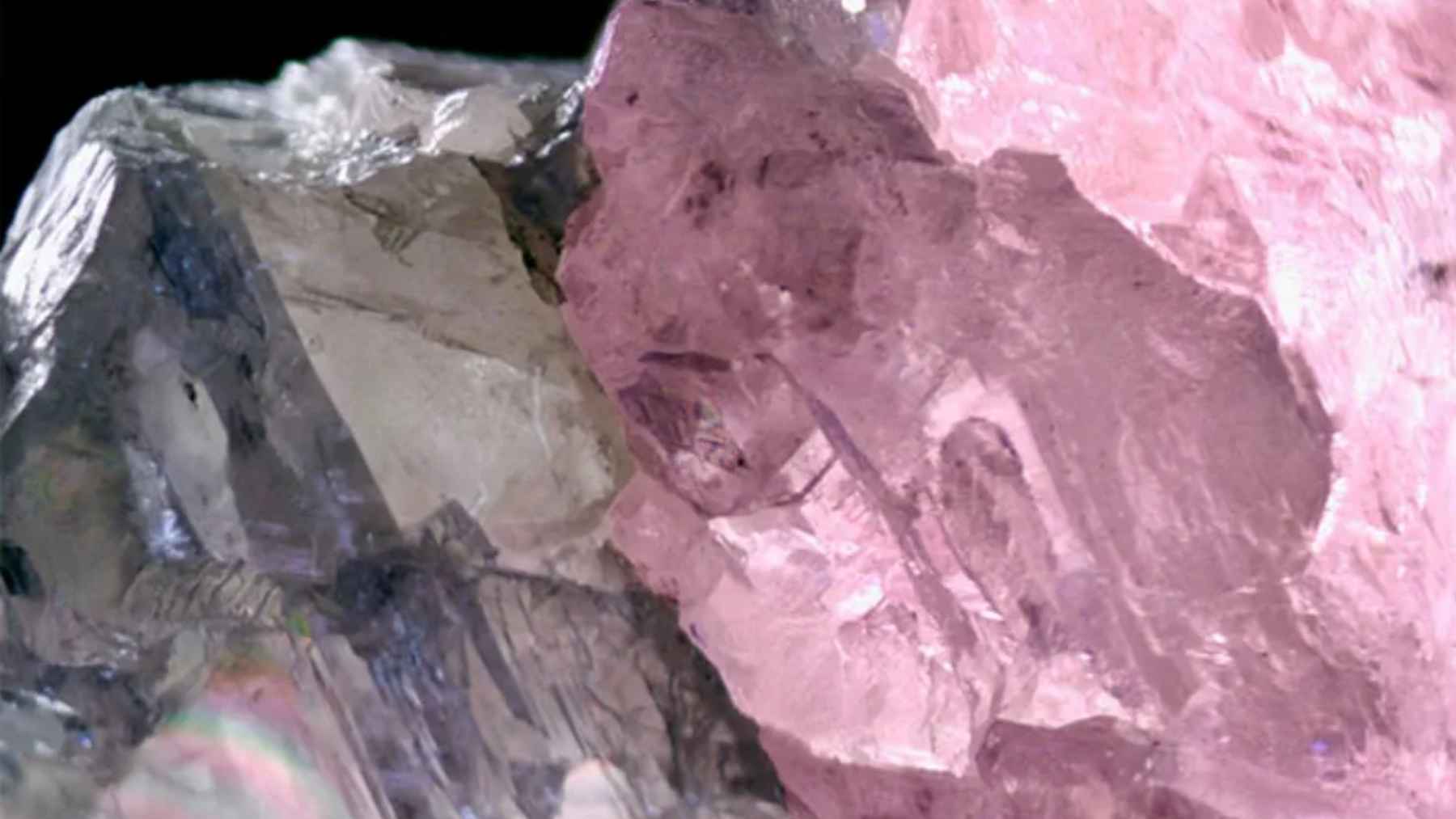
A newly studied rough diamond from Botswana looks as if it has split in two, with one side pink and the other clear.
The stone weighs 37.41 carats, measures about 1 inch long, and stands out as the largest such two color specimen examined.
Evidence from its internal structure suggests that the diamond recorded very different conditions while it was growing deep inside Earth.
Scientists at the Gemological Institute of America in Botswana (GIA) see the stone as a way to study how stress leaves a color boundary in crystals.
Inside a two tone diamond
In a recent report, gemologists describe how the stone shows an abrupt boundary where the pink section stops and the clear section begins.
Other pink and clear diamonds examined in laboratories have been tiny by comparison, weighing less than 2 carats, which makes this specimen especially informative.
The diamond was recovered from Botswana’s Karowe mine, a site that produced the 2,488 carat Motswedi and the 62 carat Boitumelo pink diamond. These unusual finds suggest that Karowe lies in crust where diamond forming conditions have remained stable and powerful for a very long time.
The work was led by Sally Eaton Magaña, senior manager of diamond identification at the Gemological Institute of America in Carlsbad, California.
Her research centers on how defects and stress inside diamond crystals create rare colors such as pink, purple, and red.
How pink diamonds get their color
Natural diamonds grow about 100 miles below the surface in Earth’s mantle, a layer of hot, dense rock between the crust and the core.
At those depths, pressure and heat force carbon atoms into a tightly packed structure that can survive the trip upward inside volcanic rocks.
Many colored diamonds gain their hues from trace atoms or radiation, but those paths almost never produce pink, reports a broad analysis.
Most pink diamonds get their color from distortions in the crystal lattice, a repeating framework of carbon atoms that preserves evidence of stress.
In a hot, buried diamond, stress can push layers of atoms into plastic deformation, permanent bending tied to pink color in one study.
“Pink color in diamonds results from significant stress causing a change in the diamond’s crystal structure,” said Magaña. When pressure during growth is off balance, a diamond often ends up clear or brown.
Reading Earth’s past in a split crystal
Light absorption tests showed a broad band near 550 nanometers in the pink side, while the clear side lacked that signal.
Both halves are type IIa, a pure class of diamonds with little nitrogen, so the color contrast reflects stress history rather than added elements.
Because the pink region carries the stress related spectral features, researchers infer that this part of the crystal was squeezed before later growth.
The clear region appears to have grown afterward in calmer conditions, attaching itself to a distorted pink core that records a mountain building event.
A crystal that combines stressed pink and clear regions serves as an experiment, letting scientists compare how one diamond responds to changing conditions.
By combining imaging with spectroscopy, the study of how materials interact with light, they can tie colors to particular pressures and temperatures inside Earth.
Tracing the pressures that shaped the diamond
Researchers studying rare pink diamonds continue to look for signs of ancient forces that acted on deep rock.
These pressures can reveal long vanished collisions between continents or old zones where the crust thickened.
The new specimen helps fill a gap because large type IIa diamonds with mixed color zones are uncommon in major collections.
Its preserved stress boundary offers clues about shifting temperatures and pressures that marked a major event millions of years ago.
Why this split diamond matters on the surface
Pink and red diamonds together make up a tiny slice of all natural stones graded, even among fancy colors that are already rare.
That scarcity helps explain why this rough diamond has already drawn strong interest from scientists as well as from future collectors.
Earlier research on natural pink diamonds found that nitrogen rich stones often show stronger color but lower clarity than nitrogen poor stones.
Having a large, nitrogen poor type IIa sample that also shows an unusual color split gives scientists and graders a rare reference case.
Each unusual stone that reaches the Gemological Institute of America origin service adds data linking color, impurities, and stress patterns to regions inside Earth.
As those links grow tighter, future diamonds may carry records that tell buyers where they were mined and what tectonic events shaped their journey.
For now, this split colored rough diamond stands as a record of a stress pulse that moved through Earth’s interior.
By carefully reading that record, researchers can learn more about how our planet slowly bends and rearranges its rocks far below the surface.