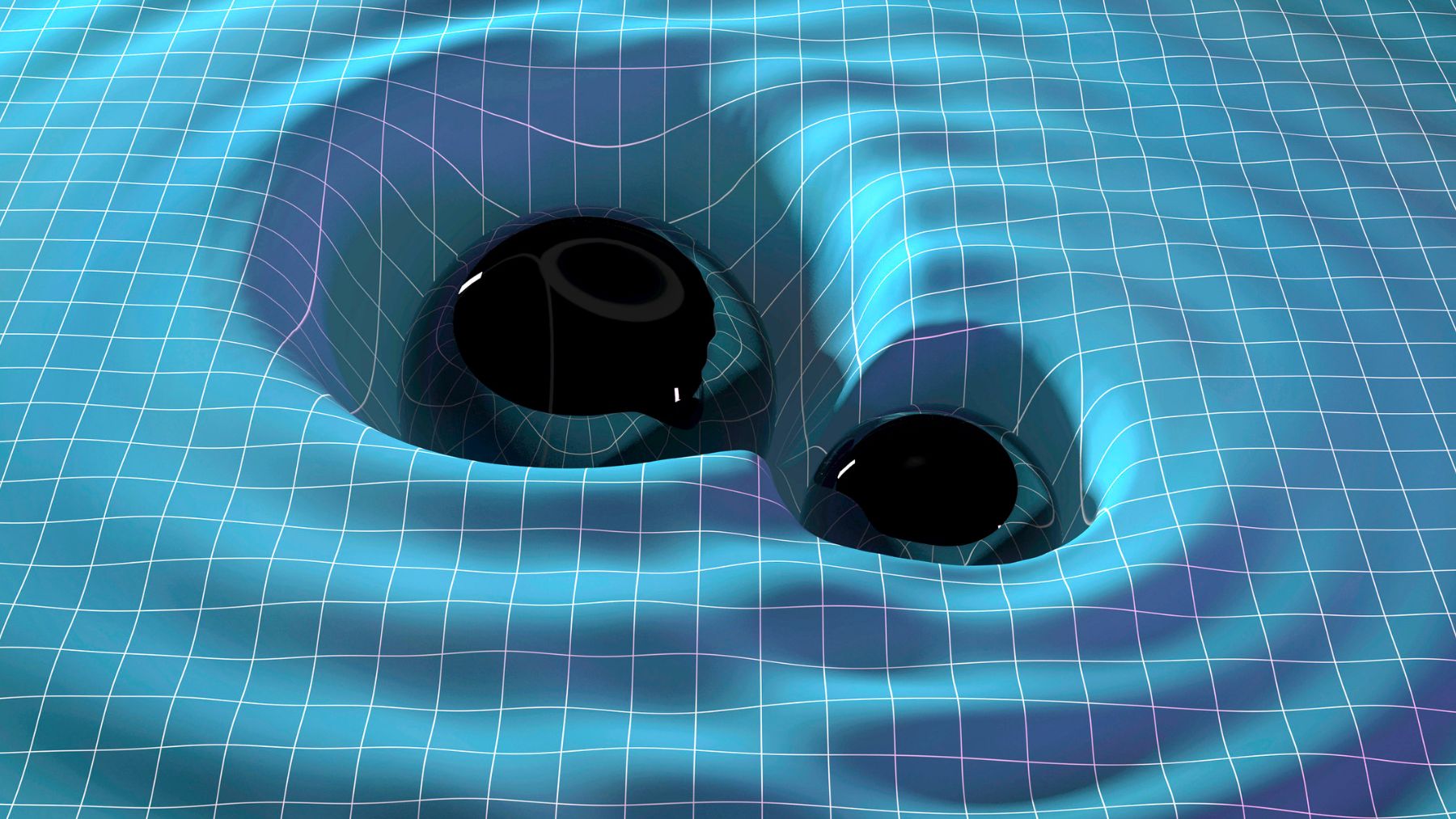
Gravitational waves are famous for shaking the universe, yet barely nudging anything around us. We have detected them with some of the most sensitive machines ever built, but a new idea asks a different question. What if a passing wave could be spotted in the light an atom gives off?
A theoretical study proposes that gravitational waves can slightly modulate the frequency of photons released by atoms, depending on the direction that light travels. The work is not an announcement of a new detector you can tour today, but it sketches a possible route to studying slower gravitational waves that current observatories struggle to catch.
How gravitational waves are detected today
LIGO opened the modern era of gravitational wave detection after recording its first signal on September 14, 2015. Its two detectors use laser interferometers with perpendicular arms that are each 2.5 miles (4 kilometers) long, built to sense unbelievably small changes in distance.
The basic idea is surprisingly simple to picture. Split one laser beam into two paths, bounce each one off a mirror, then recombine them and look for tiny shifts in how the waves line up. When spacetime stretches one arm and squeezes the other, the pattern changes.
Not every gravitational wave is equally easy to hear. Very low-frequency waves change so slowly that ground-based detectors can be swamped by local effects, which is one reason space missions like the Laser Interferometer Space Antenna are being developed to target that quieter part of the spectrum.
Why atoms might help
Atoms can emit light “spontaneously” when they drop from a higher energy state to a lower one. Think of it like a bell that rings when it settles down, except the bell’s “note” is a very specific frequency of light. Most of that light is not something you see with your eyes, but instruments can measure it.
Quantum physics adds an extra layer to the story. An atom does not shine because it stores little pellets of light inside it, but because it interacts with an electromagnetic field that fills space. If that surrounding field gets disturbed, the light an atom emits can carry clues about what happened.
Atomic clocks show why researchers care about tiny frequency shifts in the first place. GPS satellites carry multiple atomic clocks, and GPS receivers use those timing signals to find position and keep time, which is why the blue dot on your phone generally stays put even when you are stuck in traffic.
The U.S. government’s GPS site says this timing can be accurate to within 100 billionths of a second, and NIST notes that navigation apps depend on that precision.
What the new paper predicts
Jerzy Paczos said, “Gravitational waves modulate the quantum field, which in turn affects spontaneous emission,” while Navdeep Arya said, “A thorough noise analysis is necessary to assess practical feasibility, but our first estimates are promising,” in a theoretical study with Sofia Qvarfort, Daniel Braun, and Magdalena Zych.
The paper was released on March 19, 2026, and the researchers worked across Stockholm University, Nordita, and the University of Tübingen. They also suggest the relevant atomic cloud could be millimeter-scale, meaning a tiny fraction of an inch.
Their claim is not that atoms would glow brighter or dimmer during a gravitational wave event. Instead, the total light output stays essentially the same, while the photon frequency shifts slightly depending on the direction the photon leaves. It is like a steady tone that sounds subtly different depending on where you stand.
In the paper’s calculations, that directional effect shows up as extra faint features in the emission spectrum, alongside the main frequency.
Those features follow a quadrupolar pattern, which looks like a four-lobed clover when mapped around the atom, and the authors estimate that an array of roughly one million to one hundred million atoms could be enough for very low-frequency waves if the signal can be cleanly resolved.
A growing hunt for new kinds of detectors
This is not the first time atomic technology has been floated as a path to new gravitational wave “ears.” A 2012 proposal described detection strategies built around optical atomic clocks and atom interferometry, aiming to measure waves using atomic transitions as ultra-stable references rather than relying only on giant mirrors.
More recently, a 2024 study explored whether a carefully spaced atomic array could amplify a gravitational wave imprint through collective emission, meaning the atoms cooperate so the signal scales up faster than it would for a single atom.
It is a different mechanism than the new paper’s frequency shifts, but it reflects the same drive to use quantum systems to probe spacetime.
Put together, these ideas are part of a broader strategy. Instead of betting everything on one kind of observatory, physicists are building a toolkit that includes ground interferometers, future space missions, pulsar timing, and potentially lab-scale quantum sensors. The more ways you can listen, the harder it is for the universe to keep secrets.
What still has to be proven
For now, the new study is a map, not a machine. Turning it into hardware would mean measuring extremely small frequency features while controlling everyday sources of trouble like stray electromagnetic fields, temperature shifts, and vibrations. Anyone who has tried to tune a finicky radio knows how real “noise” can be.
There is also a practical question hiding in plain sight. Because the predicted signal shows up in the detailed shape of a spectrum, you would need detectors that can collect enough photons and sort them by frequency and direction with high precision. That is a tall order, even in the best labs.
If researchers can meet those challenges, the payoff could be a new window on low-frequency gravitational waves and on how quantum fields behave in a gently curved spacetime.
The main study has been published in Physical Review Letters.