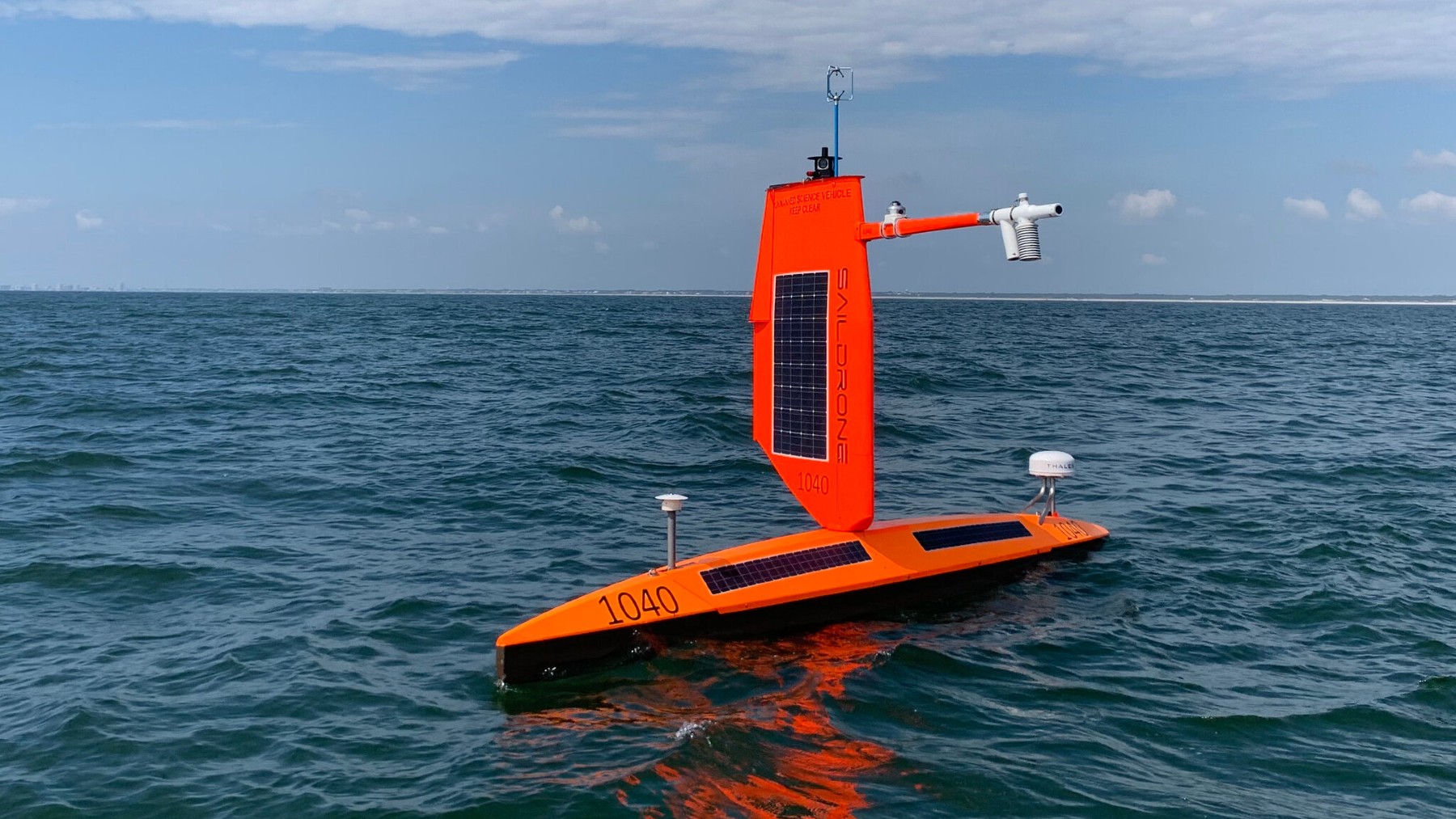
The hurricane season in America (more specifically, in the Atlantic) has already begun, and the forecasts are not good at all. NOAA has updated its information on what they call “a record season”, and the government has had to get down to work. They have had to put an emergency strategy in place, and, surprisingly, they have placed something over the sea that is going to save us from the worst catastrophes. This is how they are going to save us from monsters like Katrina or Beryl, much closer in time.
Could someday America be safe from hurricanes? Maybe, in 2024, with this new invention
Saildrone, a company that prints uncrewed surface vehicles (USVs), is working with the NOAA to observe storms in the Atlantic and the Gulf. This partnership is intended to obtain data that are important in advancing the knowledge on hurricanes and, consequently, saving the lives of many people in coastal areas.
Saildrone Explorers are built to be ready for whatever transpires in hurricanes, which are weather phenomena. As of now, they are the only USVs that can gather such information. The cars are very mobile, operate on wind and solar energy, and are long-range for meteorological and oceanographic data acquisition missions.
The particular Saildrone Explorers to be used in hurricane and typhoon tracking missions are fitted with a ‘hurricane’ wing. They are able to perform several simultaneous, or parallel measurements of the environment, such as wind, waves, temperature, pressure, and salinity (among other important aspects).
Saildrone, to prevent us from suffering “devastating” hurricanes: America is at maximum risk
The Saildrone Explorers go to specific target areas decided by NOAA’s science collaborators from the AOML and the PMEL. Every vehicle relays in-situ meteorological and oceanographic data in real time, and the data is immediately forwarded to AOML and PMEL. It should also be noted that the received data is also supplied to the Advanced Weather Interactive Processing System II.
Saildrone is a reliable platform for hurricane data collection, which is why it is the third year in a row of the USVs’ deployment for the NOAA hurricane investigation. This study is crucial to the company, and the company supports it fully; the more vehicles they can put out there, the more data Saildrone can help to provide not only hurricanes but other emergent marine challenges as well.
Five Saildrone Explorers were deployed in the Tropical Atlantic in 2021, and seven vehicles were deployed in 2022, two in the Gulf of Mexico. On these missions, the Saildrone Explorers traveled through several named storms and significant hurricanes, such as Hurricane Sam of 2021 and Hurricane Fiona of 2022.
Even category 5 hurricanes could be “dissolved”: How Saildrone works to protect us
SD 1078 Saildrone named Explorer can withstand a 50-foot height wave and wind speeds of over 100 miles per hour during Hurricane Fiona to gather scientific information. Within the storm itself, SD 1078 had meant an operation speed in the over 9 mph range, and at the highest speed of 39.7 mph, the rider could surf a bottom turn and hit a giant 55-foot wave.
The information gathered from the SQ used by the Saildrone Explorers is important in the enhancement of the hurricane forecast and the minimization of the fatalities in the coastal regions. Knowing the physical dynamics of hurricanes makes it easier for the scientists to create better models of the path radicals and intensities of cyclones.
If it is complicated to predict the exact formation path of a hurricane and formation time, then it is far more complex to determine if and when a hurricane will rapidly intensify. This refers to a condition where wind speeds increase by at least 35 mph in a 24-hour period. Category 5 hurricanes are dangerous storms that can ravage structures, crops, and people.
The project behind the Saildrome is so advanced that several countries are already considering integrating it into their hurricane defense and coastal surveillance strategies. The Caribbean is one of the regions most affected by the current (and premature) season, so we will soon see the true potential and scope of this new invention that is coming to save us all. The cost? There is nothing to see, compared to the $108 billion that Katrina “took”.