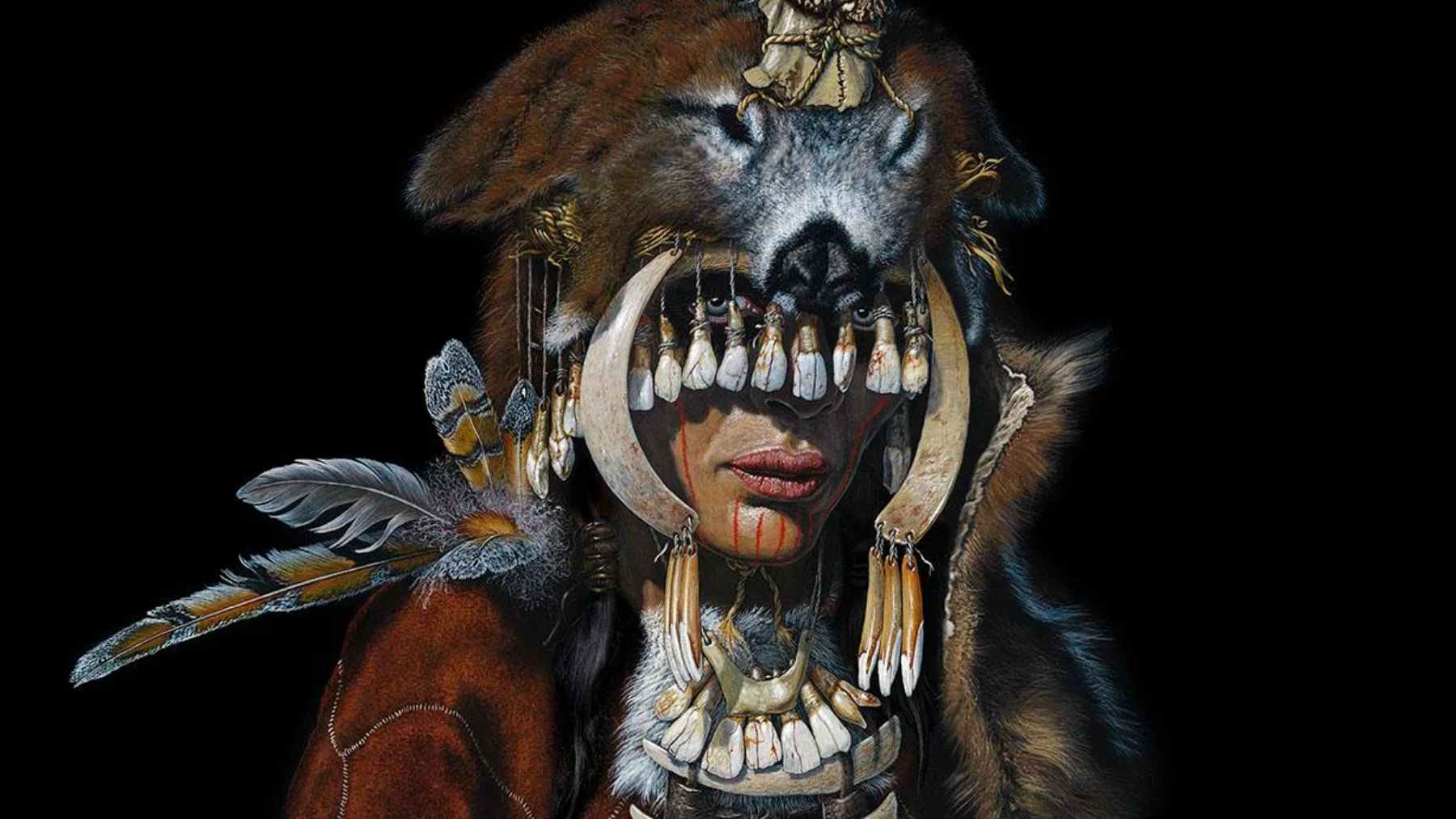
A microscopic look at a famous grave in central Germany has confirmed what archaeologists long suspected. The woman buried at Bad Dürrenberg around 9,000 years ago was laid to rest wearing an elaborate feathered headdress, and her grave kept its ritual importance for centuries after her death. Researchers now describe the burial as one of the best studied Mesolithic graves in Central Europe and one of only a handful of securely identified Stone Age shaman burials worldwide.
The grave lies in Bad Dürrenberg in Saxony Anhalt. In the Mesolithic period a woman aged roughly thirty to forty was buried there with an infant of about six months in her arms. She wore a headpiece made from deer antler and jewelry made of animal teeth, which specialists interpret as signs of a spiritual role in her community. The burial first came to light in 1934 during rushed construction work, when the contents had to be recovered in a single afternoon.
Microscopic analysis of feathers in the shaman headdress
That hurried rescue left archaeologists with a nagging question: what had they missed in the soil left behind around the grave pit? Starting in 2019, a new team reopened the site and recovered untouched blocks of sediment from the burial area. In the lab, Finnish archaeologist Tuija Kirkinen examined samples for traces of fragile materials that almost never survive, such as feathers. Under the microscope she found tiny structures known as barbules, in some cases less than a millimeter long.
The most striking result came from the area around the woman’s head. Several barbules could be identified as belonging to waterfowl, probably goose. This is the first direct proof that the shaman’s headdress was not only made of antler but was also richly decorated with feathers. The finding backs up an earlier reconstruction created for the State Museum of Prehistory in Halle, where artist Karol Schauer had already imagined the woman with a feather-covered headpiece based on comparisons with ethnographic clothing.
Feather remains and Stone Age clothing research
Feathers are notoriously difficult to trace in prehistoric graves. In usual burial conditions they decay completely, leaving no visible trace for excavators in the field. Only the hardier barbules sometimes survive, and even then they are invisible without targeted sampling.
Kirkinen’s study on feather remains in Mesolithic burials, presented in a recent conference volume on Stone Age clothing, shows how these microscopic fragments can open a new window on what people wore and how they staged ritual appearances thousands of years ago.
Ritual masks, deer antlers and songbird feathers
The surprises at Bad Dürrenberg did not stop at the main grave. Just in front of the burial, archaeologists uncovered another pit that had been dug roughly six hundred years later. Inside were two masks made from deer antlers. Samples taken from one of the antlers yielded feather remains from songbirds and from galliform birds, such as capercaillie or related species, while the other preserved scraps of bast fiber. Together, these traces show that the antlers once formed part of complex mask-like headgear decorated with feathers and plant fibers.
Why does that matter today, beyond a striking museum display? For researchers, the later pit suggests that the shaman’s grave stayed important long after her own group had vanished. Generations who came after still knew of the burial and placed valuable offerings there, treating the place as a fixed ritual point in a changing landscape.
The mix of goose, songbird and grouse-type feathers also hints at the close attention Mesolithic hunter gatherers paid to the birds and animals around them, not only as food but as powerful symbols woven into clothing and ceremony.
The Shamaness exhibition in Halle
The public will soon be able to follow this story up close. On March 27, 2026, the State Museum of Prehistory in Halle will open the special exhibition “The Shamaness,” which runs until November 1, 2026.
Over about nine hundred square meters, the show will bring together high level loans from across Europe to explore early shamanism and the wider Mesolithic world, using the Bad Dürrenberg burial as its centerpiece. A richly illustrated catalog from Hirmer Verlag will accompany the exhibition.
In everyday life it can be hard to imagine what a person who lived nine millennia ago cared about or feared when they looked at the sky or walked through the forest.
Yet in this grave, tiny feather fragments and carefully placed antlers trace a life lived between people and animals, between this world and another. For visitors who stand in front of the reconstructed burial in Halle, those details may feel surprisingly close to home.
The official press release with these results was published on idw-online.