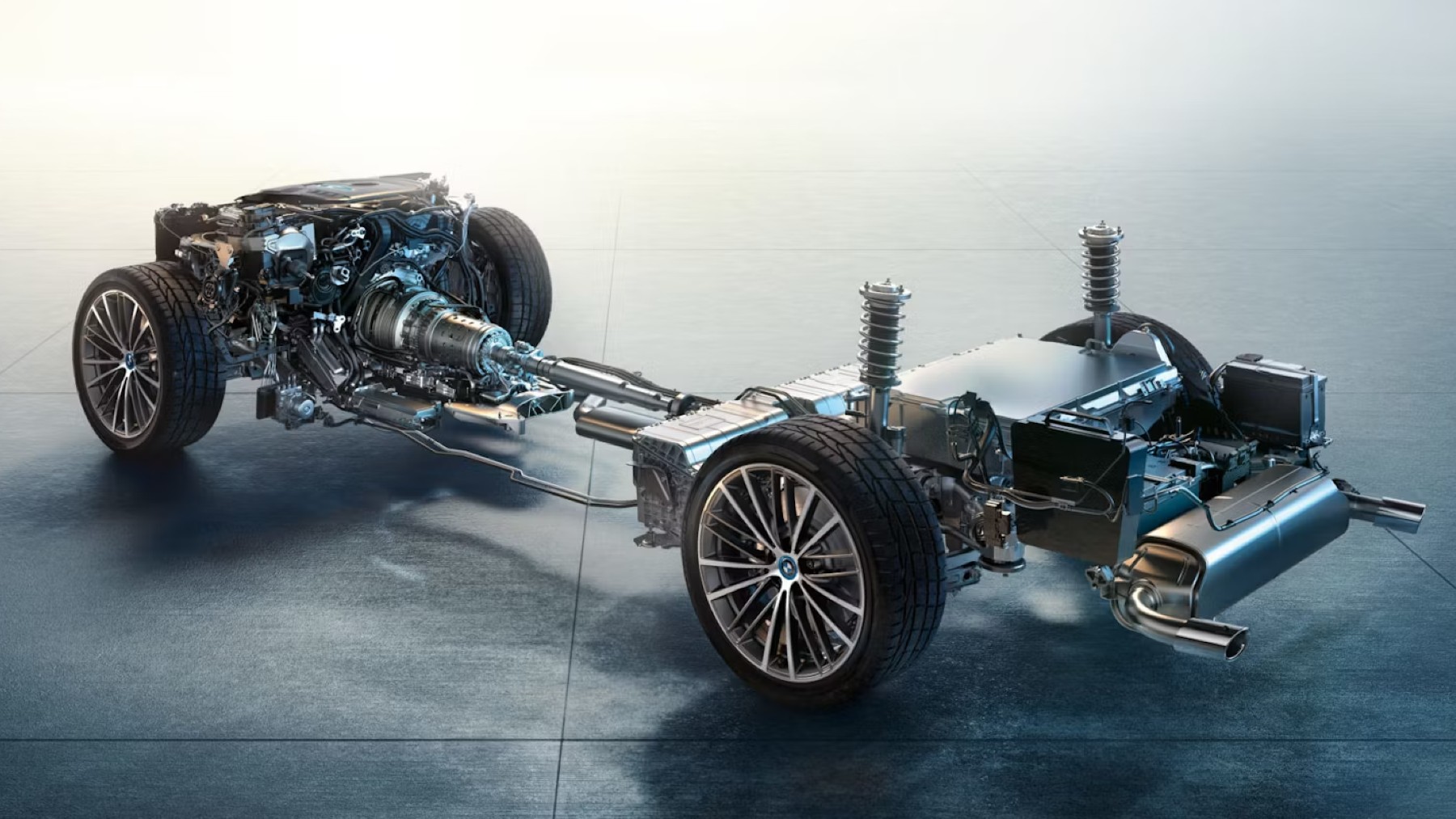
Germany’s motor industry is advancing by leaps and bounds, surpassing even Toyota’s hydrogen, which seems to remain a mere experiment compared to the innovation of Volkswagen or Renault. Right in the middle of its “golden age”, experts from half the world have been shocked to learn about the new engine launched by a mythical brand in a European country. It is so strange, it is not even placed under the hood and uses no fuel, although it has zero emissions.
This is the most futuristic engine ever: It does not go under the hood, but in this part
At present, BMW is in the limelight for its new product innovation of incorporating in-wheel motors in electric vehicles. This electric drive system, which was jointly created with Munich’s startup DeepDrive, will revolutionise the world of electric mobility. Innately, the cylindrical-shaped motor of BMW’s new in-wheel motor is the result of DeepDrive’s innovative radial-flux dual-rotor technology.
This unique design sets it apart from conventional electric motors in several key ways:
- Dual-Rotor Design: In traditional electric motors, while the stator moves an internal or an external rotor in motion, DeepDrive’s technology enables the stator to directly drive both the internal and external rotors. This intelligent design leads to a smaller motor unit that is more efficient in its use of power.
- Compact Size: The dual-rotor concept designed is very efficient in that it integrates two electric motors into a single unit – the drive unit. It also has a compact design, which enables it to be installed directly within the wheel hubs and therefore presents new possibilities for automobiles and their space utilization.
From its unprecedented performance to its unexpected efficiency: The BMW in-wheel engine, in detail
While specific power figures for BMW’s implementation are not yet public, DeepDrive’s technology boasts impressive performance metrics:
- Efficiency Gains: An innovative dual-rotor configuration is likely to enhance the vehicle’s efficiency by as much as 20 percent more than any other electric motor. This large improvement could mean an increase in the range of EVs.
- Torque Output: Purchasers can get DeepDrive with different types of motors for various types of automobiles. The company’s best model is the RM 2400, which has the ability to produce up to 2400 Nm (1770 lb-ft) torque.
- Power Output: The RM 2400 variant is capable of delivering up to 250 kW of maximum power output, which is more than enough for myriad vehicle types.
- Weight Reduction: However, this engine is not its heaviest, since the RM 2400 only weighs 37 kg and generates a powerful output. This makes it easier for vehicles using the technology to be lighter, thereby improving efficiency and performance.
Why develop an in-wheel engine? This new technology could be better than we thought
The in-wheel motor technology offers several performance benefits:
- Improved Range: The 20% improvement in the efficiency that LTEA can offer means a 20% increase or improvement in the driving range of the vehicles in the electric cars or a 20% reduction in the size of the battery to be used but with the same range.
- Enhanced Vehicle Dynamics: Since every wheel has its own motor, it seems to make ends meet with torque vectoring, which may promote handling as well as traction control.
- Space Efficiency: This reduces the space requirement for a central motor, a transmission and other drive train attributes and hence the in-wheel motors offer more space within the car for other uses or innovation.
- Reduced Complexity: The concept of in-wheel motors is less complex in compare to RWD, and this can reduce manufacturing costs and reliability.
This new BMW in-wheel engine is closer to being the prototype that the country has been waiting for years to revolutionize the zero-emission industry. The challenge remains to overcome the high tariffs that China intends to impose to avoid what they have called “unfair competition” and which will dominate the motoring news in the coming months (we will see what effect this has on our industry, of course).