From the shore, the South China Sea can look calm and familiar. About 5,344 feet down (1,629 meters), it is another world, and a Chinese research team just got a rare look at it using an unusual kind of bait.
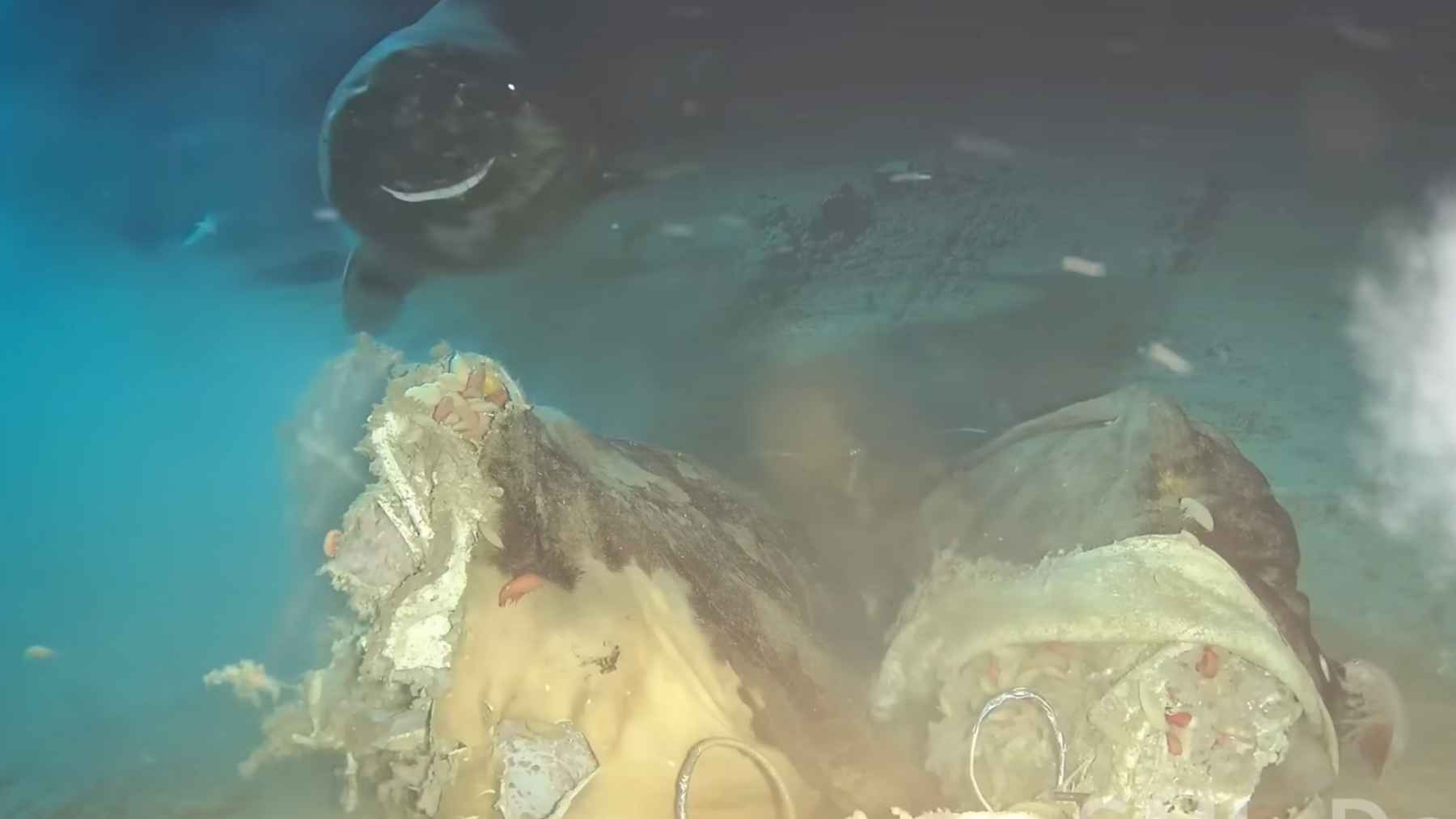
In a seafloor video recorded southeast of Hainan Island, eight Pacific sleeper sharks (Somniosus pacificus) appeared around a dead cow set out for a deep-sea “food fall” experiment.
The sighting is a big deal because the species had not been formally reported in the South China Sea before, and even basic facts about its life are still surprisingly hard to pin down.

A “whale fall” idea, with a cow doing the stand-in
When a whale dies offshore and sinks, the body can become a temporary hotspot for deep-sea life. These “whale falls” can feed scavengers, bacteria, and even chemosynthetic communities for years, sometimes far longer depending on conditions and how much material remains.
To mimic that sudden pulse of food, researchers deployed a processed cow carcass and a metal-framed camera cage on the continental slope, then watched what showed up. The setup was placed on November 3, 2022, and monitored through November 21, with the cow and camera cage positioned about 6.6 feet apart (2 meters) and checked using a remotely operated vehicle.
Eight sharks where no one expected them
Pacific sleeper sharks are built for cold, dark water, and they often stay out of sight along deep continental shelves and slopes. A NOAA scientific review notes that “little is known” about even the most basic parts of their biology and ecology, even though they turn up as bycatch in multiple commercial fisheries.
They also have a broader range than many people assume. That same review describes a North Pacific distribution stretching from places like Palau and Taiwan to Japan and Siberia, across the Bering Sea and Gulf of Alaska, and down the west coast of North America to Baja California, with additional low-latitude records in deep waters.
What the cameras actually caught
In this South China Sea deployment, the researchers differentiated eight individual sharks on camera and estimated lengths from about 6 to 17 feet (1.9 to 5.1 meters). They describe it as the first report of the species in the South China Sea and say the footage shows the sharks actively tearing at the carcass on the seabed.
As for sex, there is an important caveat. The team could not confirm it without physical specimens, but they write that the individuals “seem to be female” based on pelvic-fin features visible in the video.
A surprisingly orderly deep-sea dinner
Instead of a chaotic feeding frenzy, the camera captured something closer to a dinner line. The sharks tended to take turns, with later arrivals approaching from behind and earlier feeders giving way, a pattern the authors describe as “queue-feeding” or sequential feeding behavior.
The team also noticed a split in behavior based on size. Larger individuals, above about 8.9 feet long (2.7 meters), were bolder at the carcass, while smaller sharks often circled and waited for a safer opening.
It sounds almost civilized, right? There is likely a hard-nosed reason. In the deep sea, injuries can be costly, and meals can be rare enough that it may be smarter to avoid a direct fight, even if you are a top scavenger.
Eye protection in a messy meal
One of the strangest details in the footage was how the sharks handled their eyes while feeding. The report describes a noticeable eye retraction movement, which could help protect the eye during tearing, bumping, and close-contact feeding.
That matters because this species lacks a nictitating membrane, a protective “third eyelid” seen in some other sharks. In practical terms, eye retraction may be the built-in safety feature that keeps vision intact when a big carcass turns the seafloor into a crowded dining table.
The cow drew in an entire community, not just sharks
The sharks were the headline, but they were not the only visitors. The researchers also documented other deep-sea animals in and around the carcass zone, including snailfish, deep-sea amphipods, and a giant isopod from the genus Bathynomus.
Even the sharks carried signs of the wider food web. Some individuals had parasitic copepods attached near the eye region, a reminder that ocean ecosystems are built from tiny relationships as much as dramatic predators.
Food falls like this work a bit like a pop-up market in a remote town. They concentrate energy, pull mobile scavengers in from far away, and leave behind enriched sediment that can keep feeding smaller organisms after the biggest bites are gone.
Why the South China Sea sighting matters now
At first glance, a cold-water shark showing up at tropical latitudes sounds like a climate story. But depth changes everything, because deep water can stay frigid even when the surface is sticky-hot, and research on the South China Sea shows temperatures dropping to about 38°F (3.5°C) by around 3,937 feet (1,200 meters) and staying below about 37°F (3°C) deeper down.
So the sharks may not be “moving into warm water” at all. Still, the authors of the South China Sea study estimate the documented range has expanded by about 750 miles westward (1,200 km) and 450 miles southward (730 km), and recent record-high coastal temperatures along parts of China’s shorelines are a reminder that change near the surface can eventually ripple downward through food webs.
For conservation planners, the bigger takeaway is uncertainty, and uncertainty is not your friend when a species is slow-growing and frequently caught by accident. NOAA scientists note that the Pacific sleeper shark’s IUCN status was updated from Data Deficient to Near Threatened and recommend a precautionary approach to management while key knowledge gaps remain.
The study was published in Ocean-Land-Atmosphere Research.