China is encouraged to create energy with raindrops. You can do it at home and earn money. The enormous importance of renewable energies is already undeniable. Global warming and climate change are a devastating reality that has changed a large number of landscapes on our planet. Areas that were once teeming with vegetation and life are now plagued by drought and shortages.
On the other hand, climates that were once characterised by four seasons are now characterised by only one or two seasons a year. The world is changing and, if it continues along the same lines, humanity is at risk of suffering the consequences of the advance of these two enemies of the Earth. That is why the authorities and different energy companies have set out to find new ways of supplying energy to mankind.
Dependence on fossil fuels has led us to a complicated situation due to the release of greenhouse gases detected in their burning. This is why turning to renewable and clean energy has become much more than an option.
China creates energy from raindrops – you could do it in your own home
In the race for solar panels, China has gone one step further and used its technology to create energy from raindrops. We are talking about a ‘small-scale version’ of hydroelectric power, which boosts the possibilities of solar energy. In China, plants with a different way of achieving renewable energy are being considered.
Why? They are looking to harness solar panel technology to get energy from raindrops. A work presented in iEnergy. When raindrops fall from the sky they can generate a small amount of energy that, if optimally harnessed, can be converted into electricity.
‘They contain abundant renewable, kinetic and electrostatic energy,’ says Zong Li, a professor at Tsingua University in Shenzhen, along with other professionals with whom he co-signed the iEnergy article. In his view, it is a ‘small-scale version’ of hydropower, which harnesses the speed of water to generate kinetic energy. Then, with the help of a turbine and a generator, it transforms it into mechanical and finally into electricity.
Although scientists have devised different ways of producing clean, renewable energy from these drops of water falling from the sky, it has not been an easy task because the challenge remains to develop them on a large scale. ‘Harnessing it is a hot research topic,’ they warn.
Scientists have a device, a triboelectric nanogenerator (TENG), that can successfully harvest energy from raindrops with ‘liquid-solid contact electrification’.
This Chinese technology is also used to harness wave energy and other forms of triboelectric generation, which is usually achieved by friction between two surfaces.
China surprises with new way to create energy: Using raindrops
Problems arise when using droplet-based TENGs (D-TENGs). ‘Although D-TENGs have a very high instantaneous power output, it is still difficult for a single one to continuously supply power to megawatt-level electrical equipment. It is very important to achieve simultaneous utilisation of several D-TENGs,’ argues Li. In China, they are looking to solve this problem.
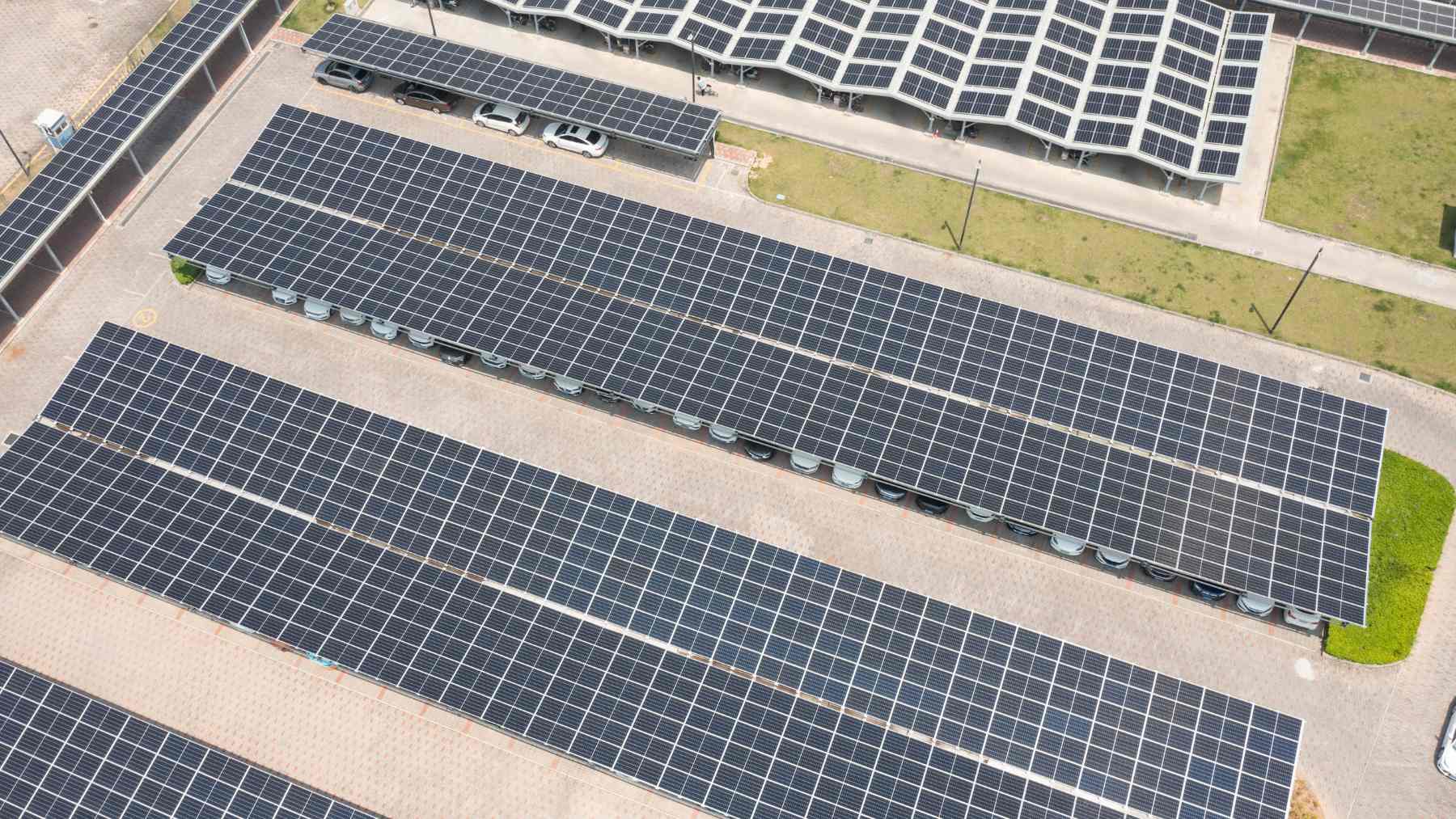
‘When collecting energy from dense raindrops instead of a single one, a more rational structure is needed to eliminate the mutual influence of individual generating units,’ the researchers say, adding that their solution is a bridge array generator (BAG) “similar to a solar panel”.
‘They adopt the array bottom electrode (ALE) and bridge array generator to make each power generation unit independent of each other as well as eliminate the influence of electrodes, which makes the output power of large-scale D-TENGs remain high and independent of size.’
The Chinese researchers are convinced that their results could pave the way for raindrops to be harnessed ‘on a large scale’. Following their model, you could create energy at home and make money, for example, by tapping into solar communities.