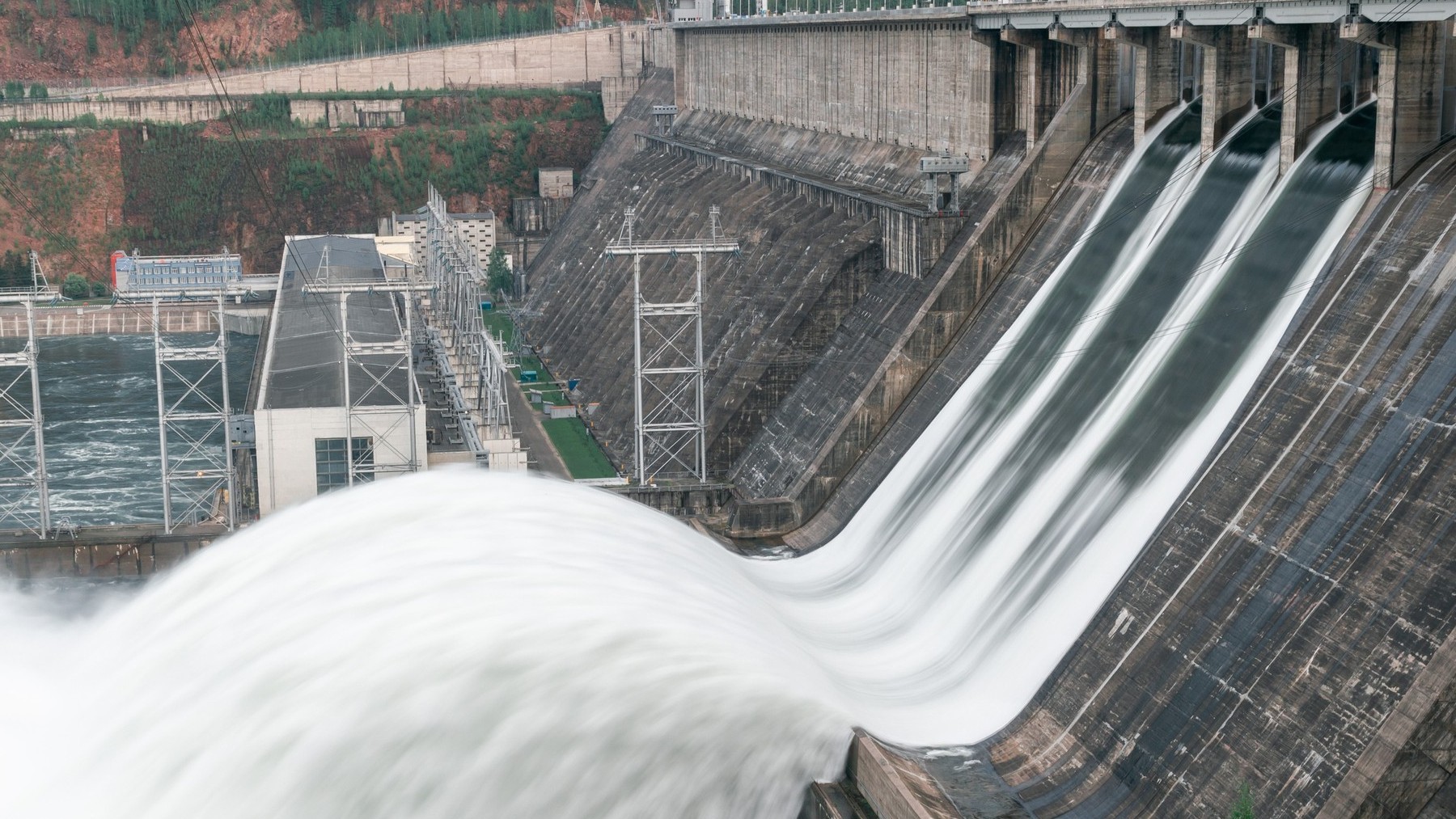
There is a hydroelectric dam that extends the length of days. After 40 billion liters and 90 years under construction, we can say so. The push by the government to build a hydroelectric power plant was surprising news, but nothing compares to what we are going to tell you now.
Dams bring great benefits to their surrounding areas, such as power generation and flood protection. Generally speaking, hydroelectric power plants are made up of three parts. The first is a power plant where electricity is generated, the second is a dam that can be opened or closed to control the flow of water, and the third is a reservoir to store it.
The water behind the dam is drawn through an intake and pushes the blades of a turbine, causing it to rotate. Its turbine turns a generator to generate electricity. The amount of electricity that can be produced depends on the distance the water falls and the amount of water flowing through the system. Electricity can be moved through long-distance power lines for domestic, industrial or commercial use.
Although there are many well-known dams, none has achieved as much popularity as China’s Three Gorges Dam, the largest dam in the world.
A hydroelectric dam has achieved something unprecedented: many do not quite believe it.
Its connected reservoir can hold such a large volume of water that it has changed the Earth’s rotation. It has extended the length of the day by 0.06 microseconds. It all began in 1919. Built along the Yangtze River in Hubei Province, its approach came in the year named after the first president of the Republic of China, Sun Yat-Sen.
He decided that its creation was a good idea as a flood control measure for the river and a way to create energy, but one of the most compelling reasons was to make the dam a symbol of power for his country. Although it is such an old idea, its construction did not begin until 1994 and its operation would not begin until 2009.
The dam has large dimensions. It is more than 2 kilometers long and 182 meters high. At its maximum point, it can hold 42,000 million tons of water. Its construction required 510,000 tons of steel, equivalent to 60 Eiffel Towers.
This dam has three objectives: to control floods, produce hydroelectric power and improve navigation. It is worth noting that the Three Gorges now produces 11 times more energy than the Hoover Dam, the world’s largest power plant with 22,500 MW. With the help of 34 huge generators, it supplies a large part of China.
Along the same lines, it keeps the Yangtze River, the third longest in the world, under control in times of flooding, protecting nearby cities such as Wuhan, Nanjing and Shanghai.
This hydroelectric dam extends the days: we tell you how
Storing such an exorbitant amount of water comes at a cost. When the reservoir is filled, the weight of the mass, more than 39 trillion kilograms, is enough to slightly change the Earth’s rotation. The key to this process is the Earth’s inertia, which depends on its mass (water) and its distribution relative to the axis of rotation.
The Earth’s axis is an imaginary pole that runs through the center of the Earth from top to bottom and the Earth rotates around it, making one complete rotation every day. As mass is distributed around the planet, this modification slightly alters the rotation. And the greater the distance of a mass (relocation of water from other areas to the Chinese reservoir) to its axis of rotation, the slower it will rotate.
As a result, it affects the length of the Earth’s days. When the mass changes, so does the rotation and spin. Raising 39 trillion kilograms of water 175 meters above sea level raises the Earth’s inertia and slows its rotation.
In short, this hydroelectric dam in China lengthens the length of days. A revolution in the world of hydroelectric power, which we have told you more in previous articles.