Analysis of the Flame Nebula through the James Webb Space Telescope confirmed the occurrence of star creation processes. This astounding finding produced essential breakthroughs in both star development research and space-related scientific mysteries. This article in-depth examines this important finding.
Several stars form at extremely quick rates inside the Flame Nebula.
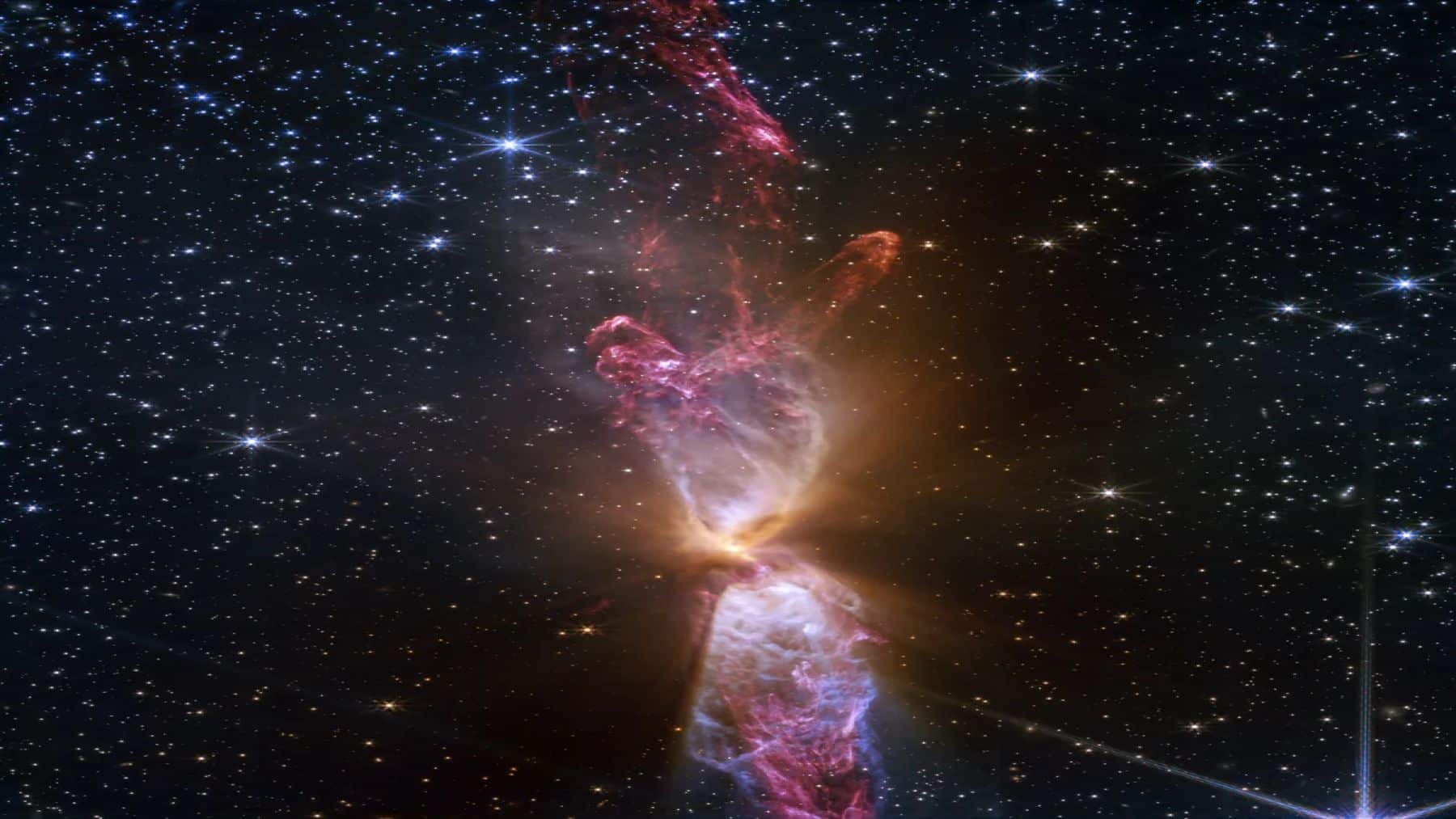
The Flame Nebula is 1,400 light-years away from Earth and acts as a dense stellar formation site for new stars. This interstellar nursery remains under one million years old. Through the James Webb Space Telescope, scientists achieved groundbreaking observations that identified the development stages behind star formation processes.
Scientists using the Flame Nebula discovered tiny objects that will forever lack the ability to convert hydrogen into stars. By analyzing these brown dwarf celestial bodies, scientists understand the minimum size required for star formation, whether they call them ‘failed stars’ or not. Due to its high observation capabilities, the Webb telescope revealed previously hidden faint objects by crossing dense regions of dust and gas.
The hidden features of space-based brown dwarfs become visible to Webb for the first time.
Science professionals find it difficult to observe brown dwarfs, as these objects remain dim due to their lower temperatures compared to stars. During their youthful stage, brown dwarfs appear brighter because they are hotter than when they age. Through its infrared technology, the James Webb Space Telescope investigated developing brown dwarfs present in the Flame Nebula.
Astronomer Matthew De Furio, who leads a team from the University of Texas at Austin, employed Webb space telescope technology to study the minimum brown dwarf mass limitation. The researchers found free-floating objects within two to three Jupiter masses while their survey operated at 0.5 Jupiter masses and above. Scientists now better understand brown dwarfs’ origin mechanisms and their discovered characteristics.
The James Webb telescope can perform research at superior levels to its predecessor, Hubble.
Evaluation carried out by the James Webb Space Telescope benefits from observational data accumulated through approximately thirty years of Hubble Space Telescope operation. Webb’s updated features have elevated scientific research beyond what Hubble could achieve in identifying prospective subjects. The combination of Hubble’s data collection and Webb’s infrared observing abilities generated an enriched perspective of the Flame Nebula.
Space Telescope Science Institute representative Massimo Robberto mentioned that Webb conducts a “quantum leap” analysis of cosmic phenomena. Webb’s spectroscopic capabilities enable team members to analyze all objects forming stars within the Flame Nebula.
The James Webb Space Telescope’s discoveries within the Flame Nebula led to vital findings about how stars develop. Because researchers can observe faint and low-mass objects, the study of simultaneous stellar and brown dwarf formation becomes possible.
This breakthrough discovery transforms our total knowledge about the patterns of stellar creation.
The team continues studying the data, aiming to determine whether identified objects qualify as planets or if they represent exceedingly diminutive brown dwarfs. The scientific investigation will enable researchers to develop more precise star formation models while advancing our understanding of universe mechanics.
Astronomical accomplishments reached new heights due to the James Webb Space Telescope’s successful detection of stars created by the Flame Nebula region. Webb grants humanity deeper insights into the cosmos because it provides detailed information about brown dwarf characteristics and star formation processes. Star formation research receives exceptional prospects from the groundbreaking features of the James Webb Space Telescope.
The research findings raise doubts about the total number of planetary-mass bodies floating through interstellar space. Scientists believe that some of these objects developed in ways similar to stars, and others were pushed away from planetary systems. Webb’s discovery capability of these free-floating objects allows scientists to improve their theories regarding planetary system evolution and interstellar phenomena.