One of Vyborg’s most important archaeological discoveries in years has come from a place almost no one thinks about. Not a castle tower or a museum vault, but a sewer collector across the water from Vyborg Castle in northwestern Russia.
During routine repair work, archaeologists uncovered a heavy stone lid that turned out to be a fifteenth century heraldic slab from the powerful Tott family, long believed lost. The find links modern urban infrastructure to a medieval power center and gives fresh momentum to efforts to protect the city’s buried heritage.
A missing coat of arms returns
The story starts in the late nineteenth century, when young researcher Alfred Hackman carried out the first systematic archaeological survey of Vyborg Castle. He carefully sketched an unusual carved slab set into one of the castle walls, then left only his drawing behind. The original stone disappeared from view and for more than a century specialists assumed it had been destroyed or reused somewhere unknown.
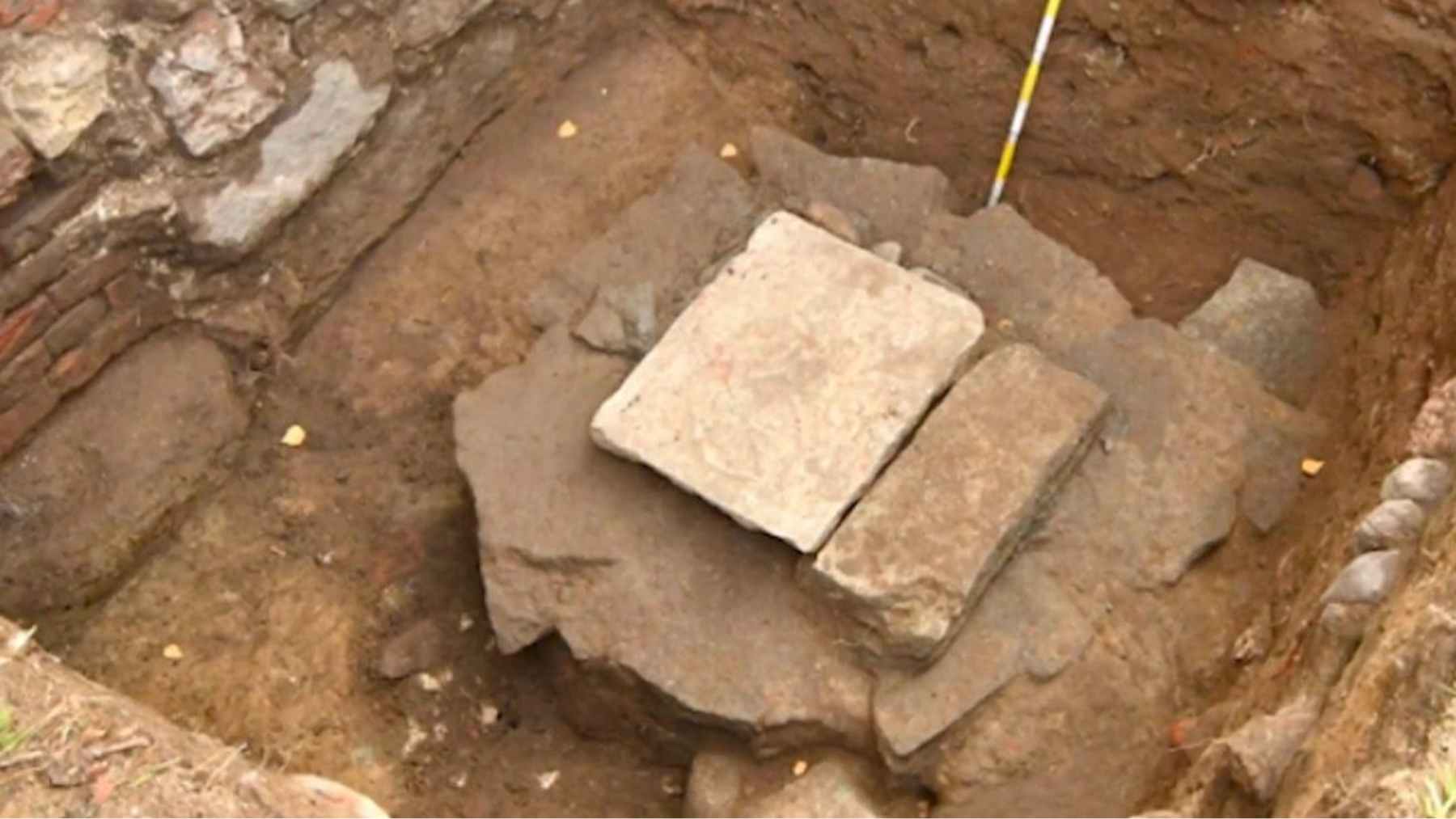
More than one hundred years later, a team from the Center for Rescue Archaeology examined a one-story building from the 1770s on the opposite bank from the castle. Under the floor they came across a sealed sewer collector with a massive stone cover. When that cover was flipped and cleaned, the carving emerged. The helmet, the feathers and the shield on the slab matched Hackman’s old sketch almost exactly, confirming that this was the lost heraldic stone that once decorated the castle’s royal chambers in the fourteen fifties.
Archaeologist Alexander Smirnov, director of the Monrepos Park Museum Reserve, described it as a genuine knightly coat of arms and said such a piece should stand at the center of the local museum’s story of the Middle Ages.
Power, stone and the layering of a city
The slab belonged to Erik Axelsson Tott, a Danish Swedish statesman who governed Vyborg Castle in the fifteenth century. Historical records show that Tott strengthened the fortress and oversaw the construction of the town wall, turning the island stronghold into one of the key defenses of the Swedish realm in the region.
Originally, the heraldic stone hung inside the castle’s royal apartments. At some point after Hackman drew it in the late nineteenth century, it left the wall and eventually ended up as the very practical lid of a sewer collector beside a later eighteenth century building.
That quiet journey from royal symbol to utility cover says a lot about how cities reuse materials across centuries. Carved stones that once projected status often become just another piece of masonry when tastes change or walls are rebuilt. In Vyborg’s case, the reuse literally buried a key piece of its political history under everyday wastewater flows.
Rewriting the early history of Vyborg
Smirnov and his colleagues have been using years of excavations to reassess how Vyborg grew. Their work suggests that when the settlement officially received city status in the Middle Ages, it may not have been a true town in the way we imagine one today. Instead, the evidence points to a fortified castle surrounded by a handful of modest fishing communities, rather than dense urban streets.
Finds like the Tott coat of arms help researchers pin down who actually wielded power here and how the landscape was organized around the castle. When a carved stone resurfaces from a sewer line, it can confirm written records, correct older archaeological interpretations and even shift how historians understand the social hierarchy around a medieval fortress.
When modern repairs uncover buried stories
The heraldic slab is not the only surprise Vyborg’s infrastructure works have produced this season. During slope reinforcement on Severnij Val Street in the city center, workers found an antique dagger at a depth of about one meter. The Government of Leningrad Region confirmed the discovery in early November, and the object was quickly transferred to specialists at Vyborg Castle for restoration and study.
Preliminary assessments date the weapon to the nineteenth century. Its outline resembles a Caucasian kama, a traditional double-edged dagger type with roots in the wider Ottoman world. Researchers note that if its historical value is confirmed, the piece will join the museum collection and add yet another chapter to the city’s military and cultural story.
All of this is happening while conservation teams work inside Vyborg’s Old Cathedral to stabilize fragile masonry, another reminder that heritage care often travels hand in hand with basic maintenance.
Anyone who has watched a street dug up for a new pipe or a hillside shored up after heavy rains knows how disruptive these projects can feel. Yet in Vyborg, they are also turning out to be opportunities. Each trench, each collector and each cut into a slope opens a small window into past centuries that would otherwise stay sealed beneath cobblestones and asphalt.
Heritage, sustainability and what lies under our feet
From an environmental and planning viewpoint, Vyborg’s experience shows how rescue archaeology can be woven into routine public works. Before an old sewer is replaced or a shoreline slope is reinforced, archaeologists can document and recover what earlier generations left behind. That approach protects cultural layers while modern systems keep up with today’s demands for clean water, safe buildings and resilient infrastructure.
There is a wider lesson for any historic town upgrading its pipes or fortifying riverbanks against stronger storms. What looks like a simple utility trench may hide pieces of a city’s identity, just as surely as it hides cables and drains. Paying attention to that possibility does not only serve museums. It helps residents understand how long people have been shaping the same island, the same shoreline and even the same strips of waterfront where they walk during a sticky summer evening.
In Vyborg, a lost knightly coat of arms now cleaned and identified will likely move from a forgotten collector into public display. The antique dagger from Severnij Val will follow if further study confirms its importance. Together they show that the past can reappear in the most ordinary corners of urban space and that sustainable city planning can include not only energy and water but memory as well.