Hydrogen mobility is the latest innovation in the industry, with the world’s top carmakers (except Volkswagen) trying to carve out a niche for themselves. However, a new engine has just challenged all known fuels, and it comes, paradoxically, from Hiroshima. It has just been unveiled, and experts fear that it will disrupt the whole decarbonization strategy we have in place. Find out who made it and how it will revolutionize the roads from now on.
Hiroshima has “resurrected” a forgotten engine: It’s better than EVs (and even FCEVs)
Thus, Mazda has been rather daring with their strategic vision in the automotive market by essentially doubling down on their signature rotary engine. While all other automakers are scrambling towards electrification and the hydrogen fuel cell vehicles, Mazda is taking a completely different path—a road that might change the very meaning and relevance of the ICE in the future.
On February 9, 2024, Mazda stated the restoration of the ‘RE Development Group’ under the Powertrain Technology Development Dept. This team, totaling 36 employees, will be focused on the engineering and development of rotary engines, which have been a major and iconic element for Mazda for many years.
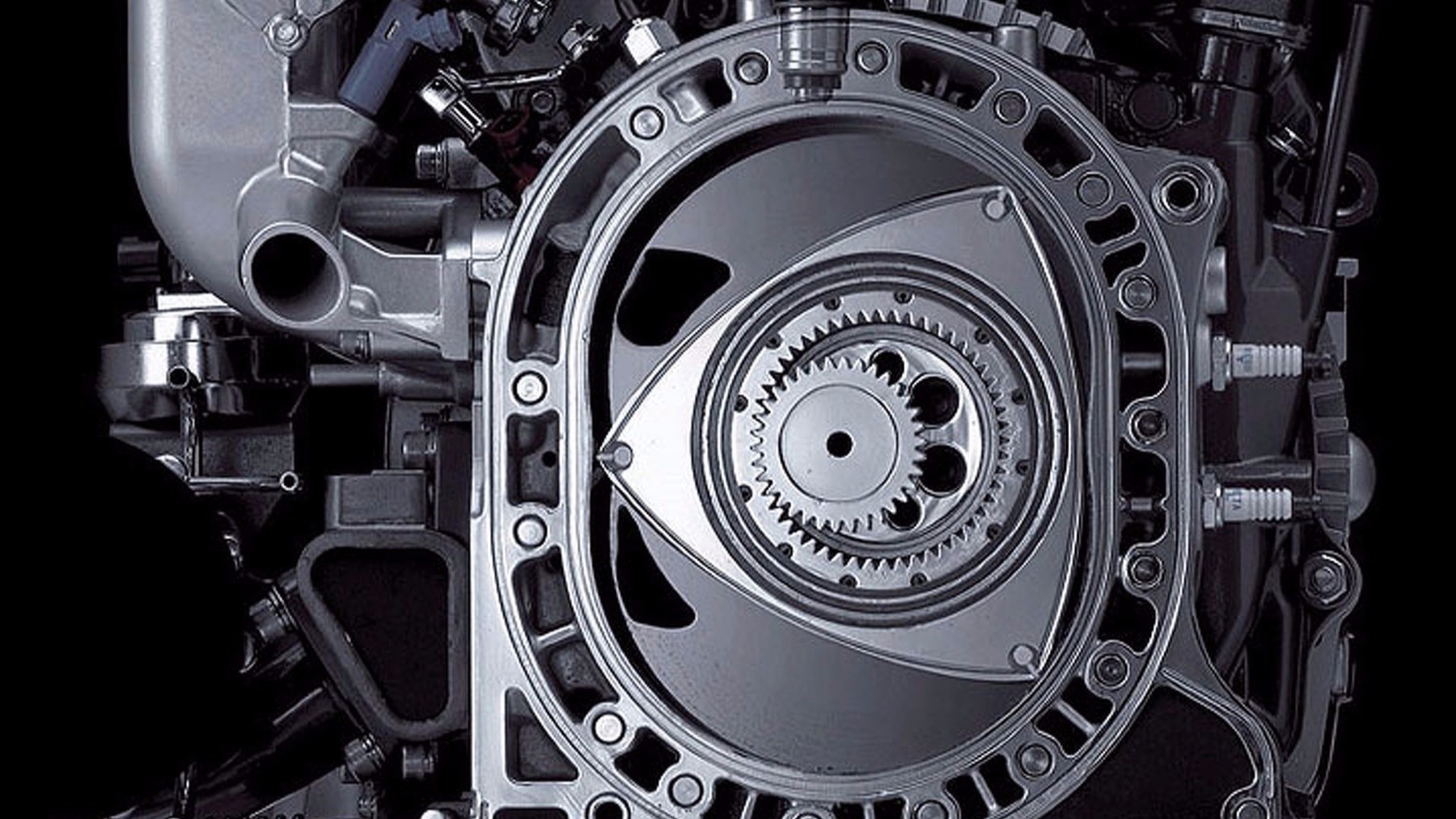
The Wankel rotary, used in Mazda as an automobile engine, is a very innovative design in which power is generated by the rotation of a triangular rotor, contrary to conventional piston-rod movements. This compact and lightweight configuration has always been a topic of controversy since people love it due to its lower stress, but regarding the engine, it has some drawbacks concerning fuel efficiency.
But Mazda is not going to give up and transition the rotary engine to the new era of carbon neutrality. The firm’s Chief Technology Officer, Ichiro Hirose said, “In the era of electrification and in a society that will strive for carbon neutrality, we will continue to provide appealing cars that elicit customers’ interest as a challenger”.
Mazda rotary engine, in detail: 17.8 kWh battery and 52-miles range, but “something unexpected”
The electricity generation capability of the Wankel’s rotary engine design is demonstrated in the present Mazda MX-30 e-SKYACTIV R-EV. This series-hybrid concept allows linking a rotary engine with a 17.8-kWh lithium-ion battery pack that should provide up to 85 km (52 miles) of all-electric range on the WLTP cycle.
The power plant comprises a rotary engine working with Spark Controlled Compression Ignition (SPCCI) technology: its primary function is to work as a range extender, which charges the battery pack when depleted. This setup enables the MX-30 e-SKYACTIV R-EV to attain a longer range in relation to conventional EVs, while also reducing range anxiety that consumers face.
Thus, Mazda believes that the compactness and inherent lightweights of the rotary engine, along with its capability to operate on carbon-neutral fuels, make it a far superior global solution to EVs and FCEVs. Company engineers still believe that they can enhance the rotary Engine to be incorporated in applications other than electric cars, including even pure electric automobiles.
Are there plans for a mass production of rotary engines? This is what the FCEVs industry fears
As of June 2023, Mazda had finally restarted mass production of vehicles with rotary engines for the first time in about 11 years with the MX-30 e-SKYACTIV R-EV. At the present time, this model is local to Japan and Europe, and Mazda is studying the possibility of this model in North America.
Apart from the MX-30, Mazda plans more models for electrification and has shortlisted the new two-rotor sports car, namely the RX. This potential model would demonstrate what a rotary engine is capable of, as well as capture the attention of enthusiasts who have always appreciated Mazda’s specialty engineering.
This new Mazda rotary engine is a step forward in ZEV (zero-emission vehicles) and could be a clear alternative to hydrogen, which still does not convince some of the most powerful brands on the planet. However, remember that this is a reinvention of a prototype that was launched at the time, but was not marketed as expected and therefore fell into oblivion. We will see what happens now (as Musk is doing).