Even if you’re not into astronomy or science, there’s no denying that everything that involves space, besides being a bit strange, is fascinating. And this only increases with each discovery. That said, astronomers were recently observing space with the James Webb Space Telescope (JWST) and found something unprecedented when observing a young planetary system more than 300 light-years from Earth. However, it wasn’t this in itself that caught their attention, but rather the clouds so dense that they hide an incandescent secret inside one of the planets.
The two-for-one discovery
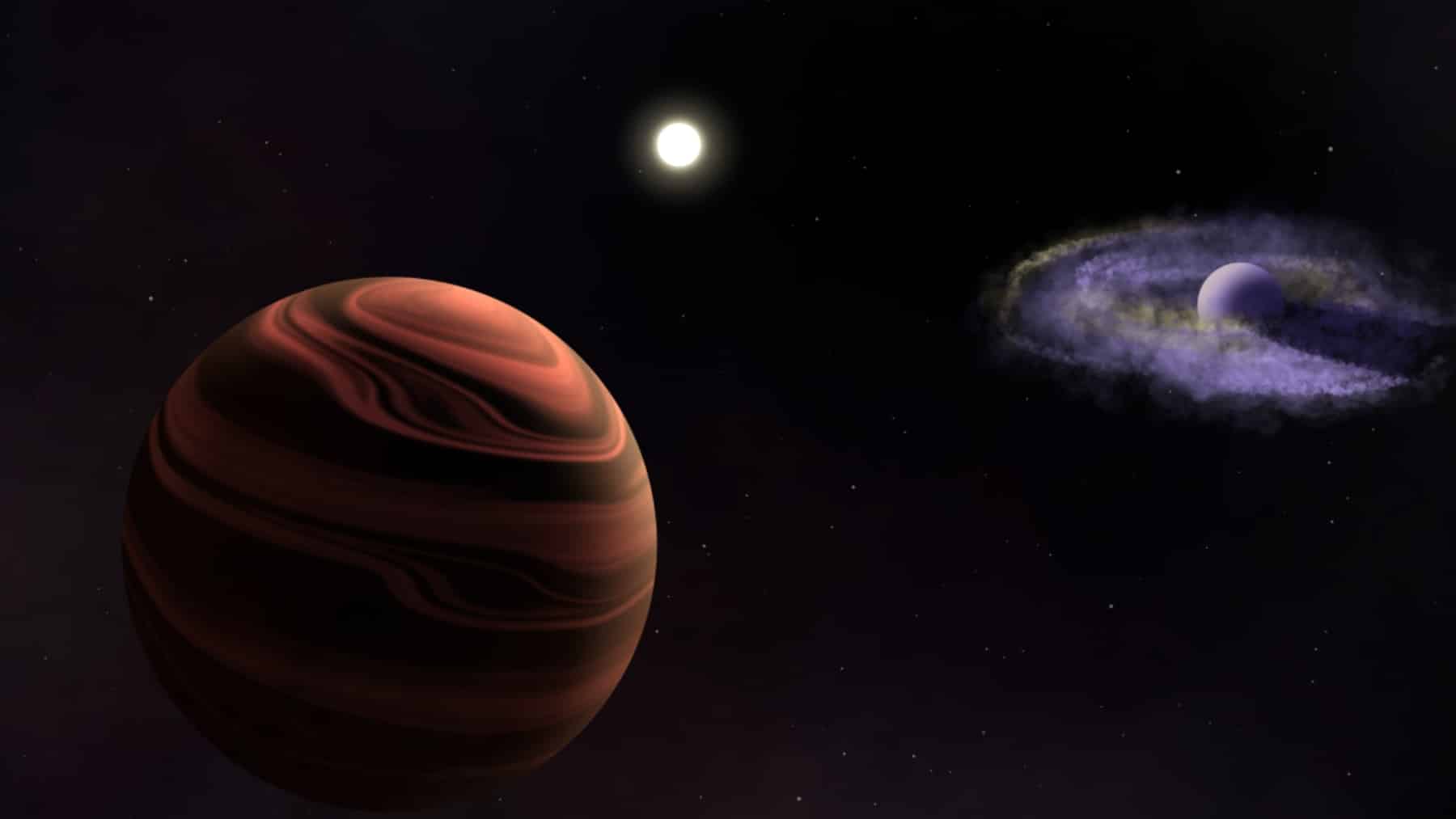
The observed system has already been named YSES-1. This planetary system is home to two gas giants that are still forming. They orbit a star similar to our Sun, but it is much younger, only 16 million years old. So, imagine the surprise of astronomers with this discovery – no one was expecting two planets in a single field of view.
- YSES-1c: This is the most distant planet and is about six times more massive than Jupiter. However, that is not what draws attention, but rather its high-altitude clouds composed of magnesium silicate dust grains, which are like sand, and possibly iron. And no, it is not like water vapor like here on Earth, but mineral materials that indicate an extremely young and dynamic atmosphere.
- YSES-1b: This is the innermost planet. And what caught scientists’ attention was something else: it still has a disk of dust around it, something extremely rare for a planet that is 16 million years old. If we think about what is considered normal, these disks disappear within 5 million years after planetary formation. In other words, the presence of this material suggests that it may be fueling the formation of moons, like Jupiter’s natural satellites, or even still transferring mass to the planet.
The planet that could go through a metallic hell
As fascinating as both planets are, there’s one that made scientists do a double-take: YSES-1c. Why? Because this planet isn’t just hiding behind clouds… those clouds might be hiding something way more intense. Thanks to JWST’s super-precise instruments, researchers picked up what could be the strongest signature of silicate clouds ever seen on an exoplanet. We’re talking about tiny mineral particles— basically, dust made of sand-like material — that get scorched by the planet’s brutal heat and pile up into thick, high-altitude layers. But what does that mean?
And when those clouds finally break? What comes down isn’t water (just like this ocean found on the Moon is not made of water) but something way more intense: liquid iron. That’s right. Iron, which exists up there in a gaseous or dust-like form, can actually condense and fall through the atmosphere, possibly reaching the planet’s surface like a metallic rainstorm.
What can these planets really teach us about the universe?
The truth is, this discovery goes way beyond just YSES-1c. Sure, learning how planetary atmospheres behave under extreme heat and pressure is already a big deal. But there’s more to it than that. What grabbed scientists’ attention was how different the two planets in the YSES-1 system turned out to be. And you might be wondering: how different? Well… if both planets were born from the same protoplanetary disk, how come one of them still has a cloud of dust swirling around it, while the other one doesn’t?
And it is this type of question that calls into question the current models of planetary formation. According to the researchers, the JWST is providing an immense amount of data to continue refining models and improving our understanding, which is essential to understanding even more about our Universe, such as this rare cosmic event that is outside the core of a galaxy.