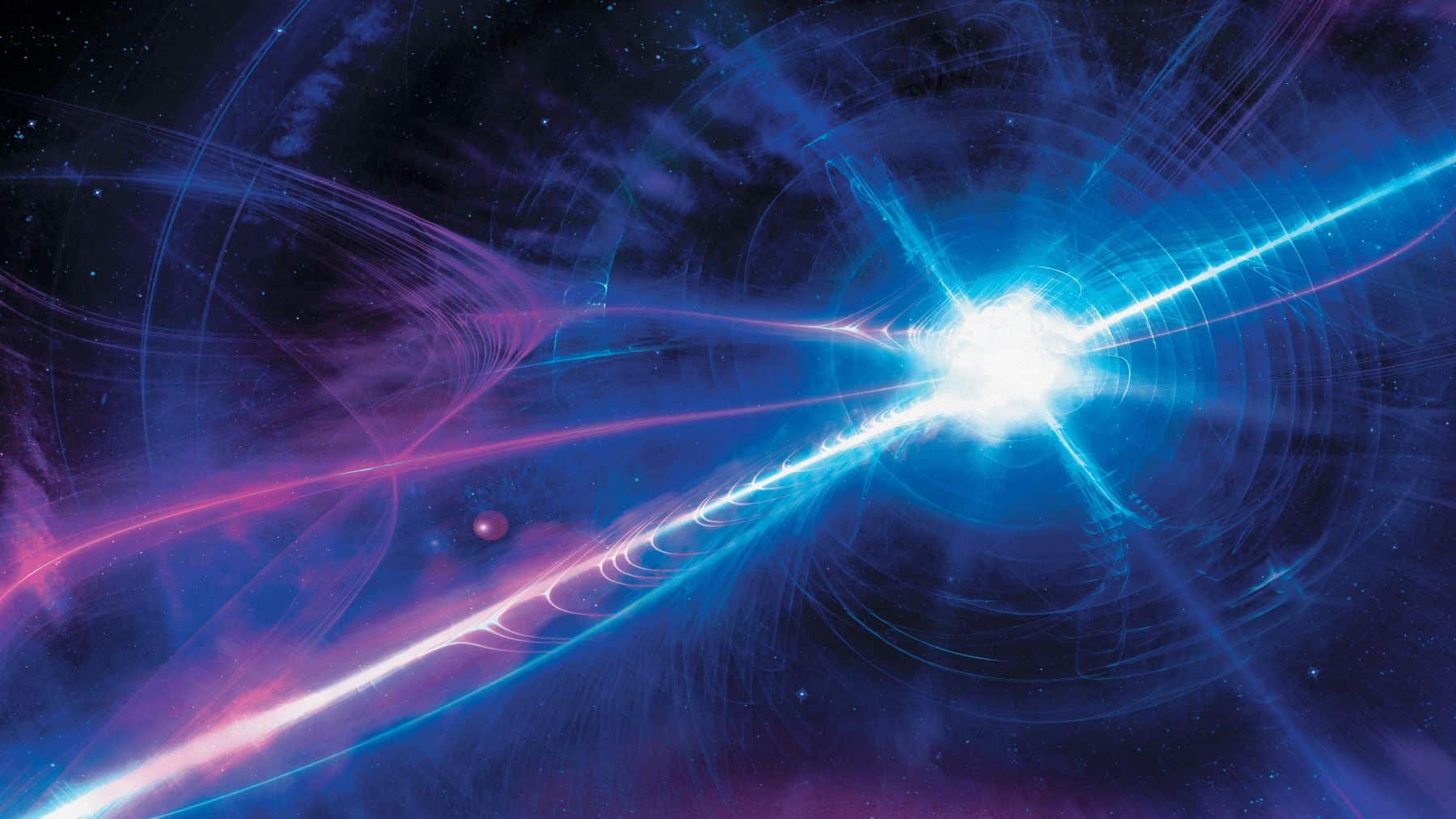
Scientific breakthroughs have allowed astronomers to track down the birthplace of a fast radio burst (FRB) to a unique space-based source. Astronomers have located the origin of the radio signal, FRB 20190208A in a dwarf galaxy that lies more than halfway through the reachable portion of the observable universe. Determining this enormous distance allows scientists to gain substantial insight into the creation of FRBs.
Scientists detected a radio burst that traveled billions of years.
The radio-wave frequencies contain brief yet potent bursts known as fast radio bursts. These brief electromagnetic explosions briefly exceed the brightness of galactic systems despite their short duration. The explanations of these events remain elusive because they could start from magnetars or advanced extraterrestrial devices. Research into FRBs becomes complex because these bursts either repeat in sequence or occur separately from each other. Research teams employ advanced radio telescopes to both receive and study these signals since they want to understand their scientific nature better.
The mysterious nature of FRBs requires investigation since their discovery teaches astronomers about the universe’s development. These signals serve as a guide that instructs astronomers to newly discovered host galaxies, including FRB 20190208A. Scientists investigate these signals to discover hidden knowledge about intergalactic space.
A repeating space signal has been traced to a tiny galaxy.
Astronomers from an international collaboration recognized FRB 20190208A for the first time in February 2019. The team employed radio telescopes to monitor the burst for approximately 66 hours until they detected it again in February 2021 and then again in August 2023. Researchers obtained repeated detections from which they proved FRB 20190208A displays recurring behavior, thus enabling better examinations of its properties.
Researchers can determine important aspects of the interstellar medium and magnetic fields through signal dispersion and polarization analysis of their data. Additional observations create discoveries that contribute to solving the cosmic nature of these flashes and their possible astrophysical origins. FRB 20190208A was the second confirmed repeating FRB, a scarce discovery until recently. CHIME was the key instrument for detecting FRB 20190208A’s position in space.
Scientists have greatly advanced in studying these space signals, representing our growing knowledge about these phenomena. Research on repeating FRBs will yield insights into their creation process while revealing information about their origin sources and space environments. New astronomical findings help scientists perfect their theories, continually leading them closer to understanding powerful radio bursts and their significance to our understanding of space.
Scientists think these extreme stars are behind the mystery
The discovery of how FRBs occur has proved challenging to scientists, but the consensus points to these events as having originated from magnetars. Effective magnetic fields exist in these stars, producing sudden energy release. The recurring Fast Radio Bursts named FRB 20190208A occur frequently in dwarf galaxies rather than typical larger galaxies. Dwarf galaxies appear to be the most suitable locations for magnetars and possible FRB sources of an unknown nature.
According to Danté Hewitt, a radio astronomer who worked on this research, ScienceAlert reported that the discovery of repeating FRBs in dwarf galaxies successfully connects repetitive FRBs to massive stars that produce them. Such massive stars produce FRB remnants that endure to generate flashes following their final catastrophic sovereign collapse.
This discovery is reshaping how we study the universe
Astronomy has gained great importance since the discovery of FRB 20190208A and its relationship to a dwarf galaxy. The galaxy dwarf environment seems to boost the natural occurrence of repeating FRBs. Special environmental configurations, such as gas metal content, seem to influence the production of FRBs. By studying these factors, astronomers can obtain more profound knowledge of space, while the ability to identify FRB origins serves as a novel investigative instrument for the universe’s research.
Scientists achieved an exceptional scientific feat by tracing FRB 20190208A to a dwarf galaxy located over half of the observable universe. Fast radio bursts and their generating environments become better understood through this discovery. Ongoing research into these mysterious radio bursts will change our knowledge about the universe and its transforming forces.