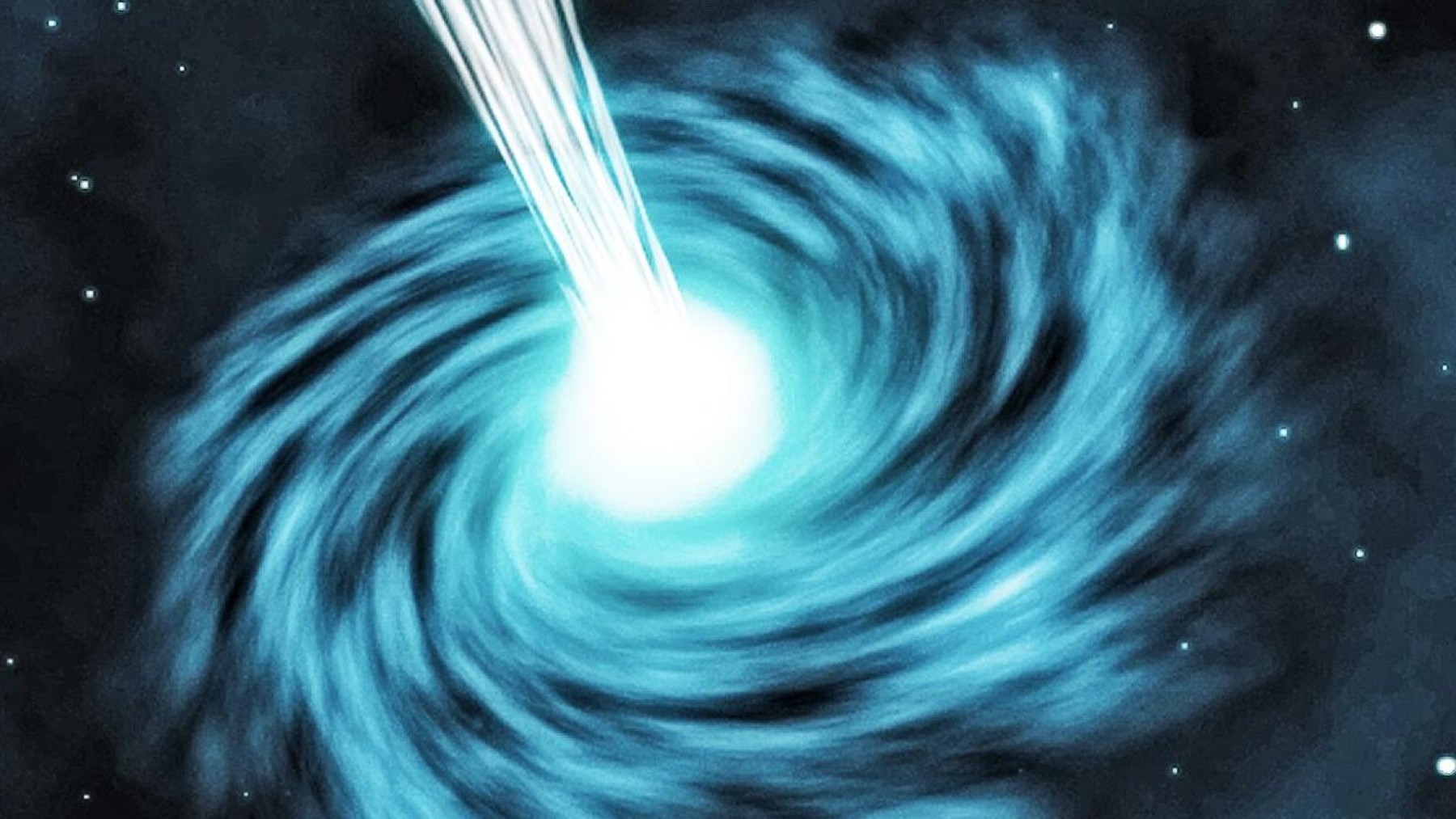
While black holes ensnare scientists and public alike, their theoretical counterparts’ white holes remain a totally mysterious and controversial concept in astrophysics. The white holes, if they exist, would behave exactly opposite to that of black holes, expelling matter and energy instead of pulling them in.
White holes: The time-reversed twins of black holes
White holes arise from the theory of gravity developed by Einstein and were proposed by the physicist Karl Schwarzschild in 1916. Much like black holes, these are solutions to Einstein’s equations, with the difference that the direction of flow in time is reverse; from a black hole’s property that everything can only enter, it becomes the opposite: a white hole can let everything escape, but nothing enters it.
In a simpler sense, a black hole is very strong gravity-pulling object and possesses an event horizon. Eventually, it transforms everything irrevocably into that horizon, which will relate to white holes by the phenomenon of “anti-event horizon.” It allows all materials and energy to be expelled yet prohibits entrance. It’s imagined as a movie of a black hole being played backward; thus, this time-reversal symmetry creates a white hole.
Mathematical fantasies: The white holes or could they also be the physically impossible?
Right now, even if it is mathematically permissible, not a single piece of observational evidence suggests that white holes exist. Some physicists, Geraint Lewis among them, argue that the asymmetry of time in the universe can even preclude the existence of white holes.
As time has had a clear direction in the universe-from the Big Bang into infinity-thus far; that is to say: time moves onward into the infinite future, someone might argue that black holes should form, but that nature prohibits white holes from coming into existence.
It would also be troublesome for a white hole to have a natural process from which it had come to being- a black hole can be formed from the collapse of a massive star. So then, it is beyond comprehension how a white hole would be born.
Unwinding a pattern of star collapse would violate the basic principles of thermodynamics, especially entropy, which observes that the universe has a progressive tendency towards more and more disorder. Matter falling back out of a white hole would be compared to egg spontaneously reconstituting-an infringement of the statistical rules of the universe.
White holes: Are they the ending of black holes?
Although theoretically existing, they appear to be tempting avenues for solving the paradoxes black holes have thrown up. Physicists such as Carlo Rovelli have begun imagining white holes as the “death” of the black holes. Just like Stephen Hawking proved, black holes somewhat evaporate over time because of Hawking radiation, but then again, the question is, what happens to the information swallowed by them?
While quantum mechanics forbids the deletion of information, general relativity asserts forever certain black holes trap it. Rovelli and others indeed hypothesize that as a black hole shrinks into some incredibly small size-that is right down into the quantum scales-it could become a white hole.
This “quantum bounce” might possibly be what allows the information to escape, thus resolving the paradox. These would be the white holes: tiny, stable, and very much less dramatic than their black hole forebears, but they could, in the end, occupy the universe-one that would be huge after the black holes have evaporated.
Theoretical physicist Hal Haggard puts this into an exceedingly long time in the future: countless trillions of years from now. Interestingly, the behavior of the Big Bang-the explosive birth of matter and energy in the universe-resembles the theoretical properties of a white hole.
From this perspective, a few cosmologists even proclaiming that our universe by itself might be the result of a huge white hole explosion. The “Big Bounce” states that a previous universe fell into a black hole and came out into the present universe as a white hole-like explosion.
White holes course as the very interesting existence-mathematically well-formed but possibly non-existent. As evidence, scientists are not quiet at loggerheads with them just for that reason, they say, it might have something to do with the whole many mysteries of black holes and the fate of the universe. Real or not, however, they do serve to give an illustration of the yearning for humans to crack the codes of the universe.