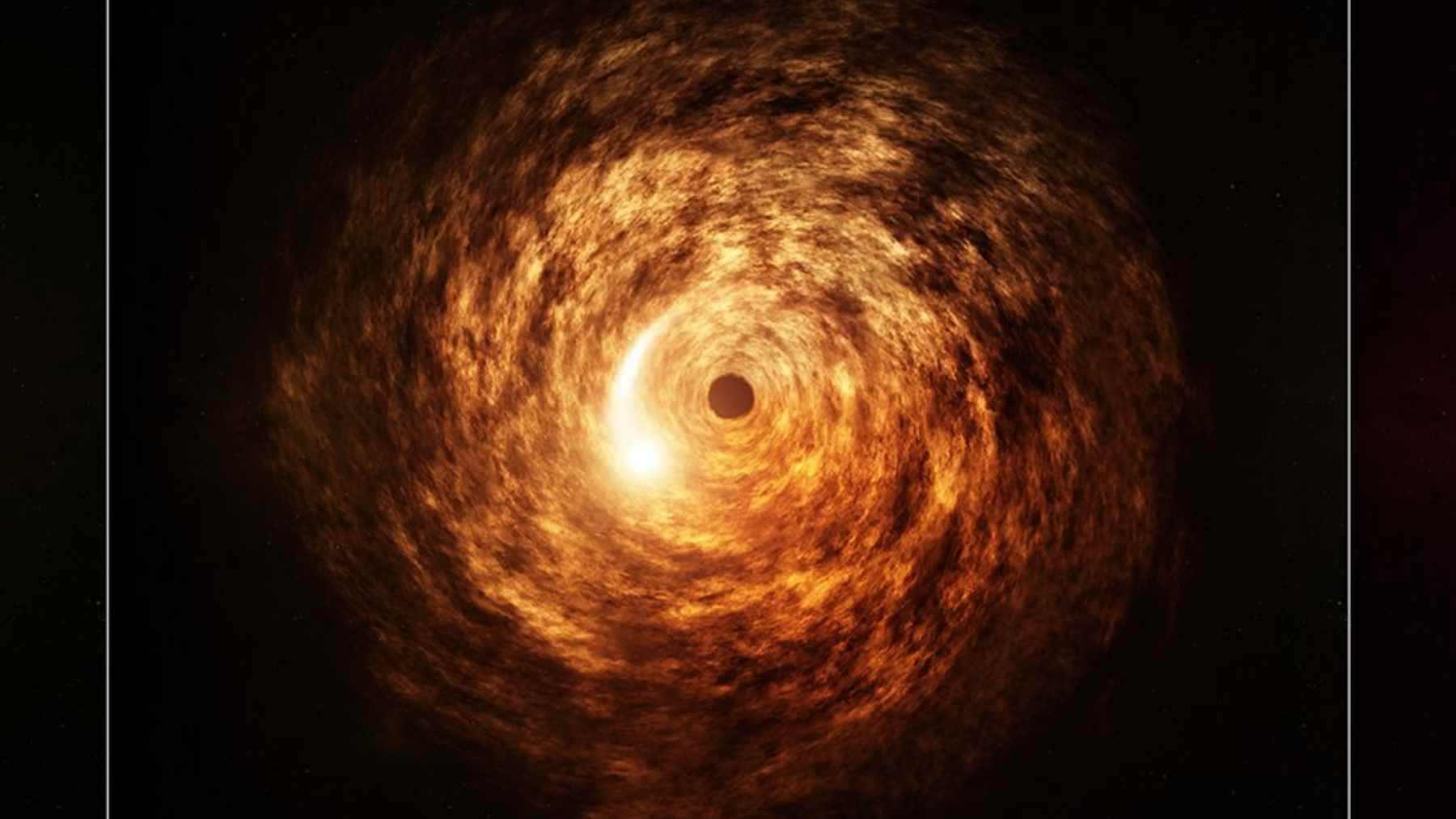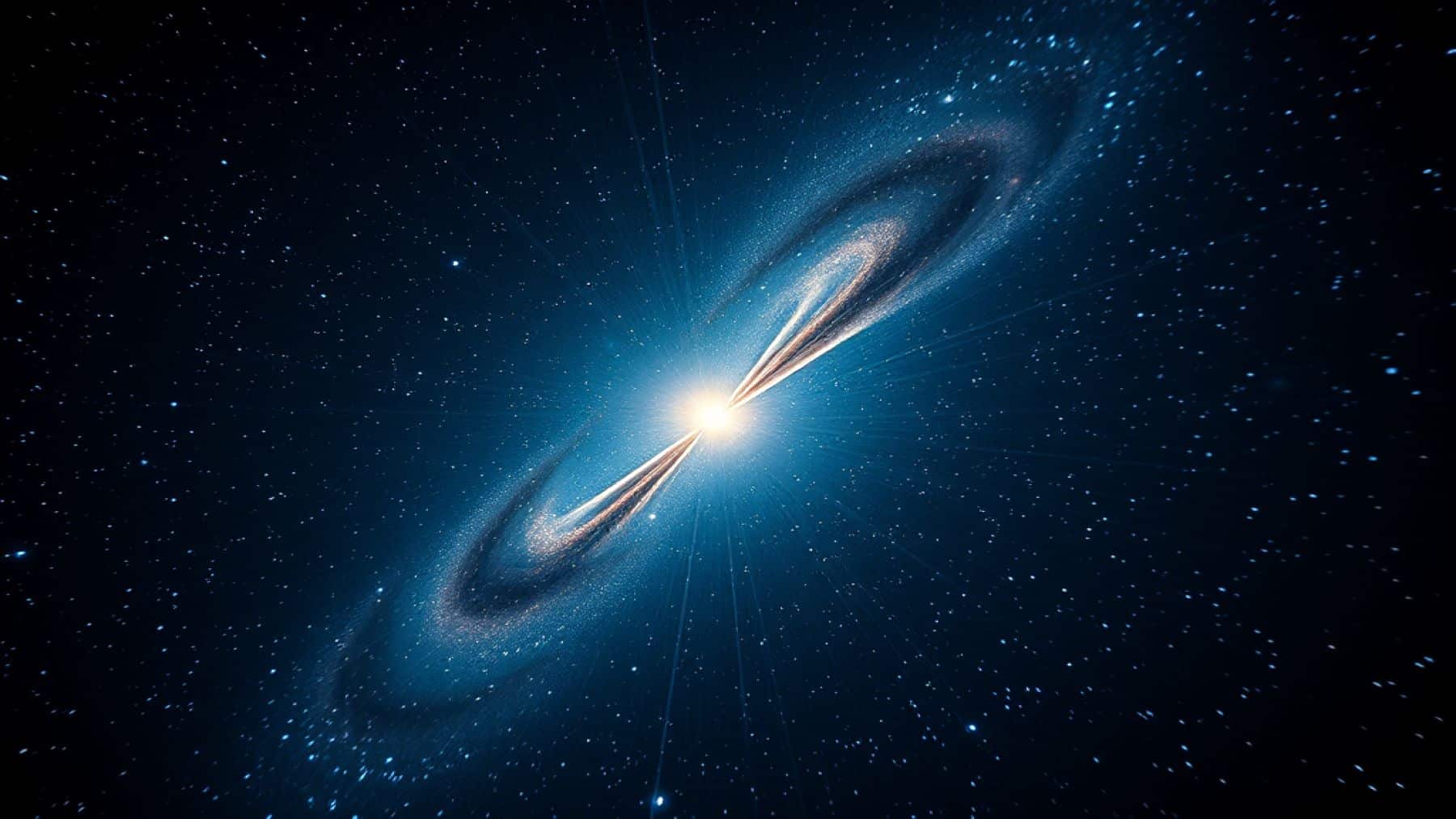
A recent NASA declaration enabled scientists to identify an unprecedented scientific discovery. A supermassive black hole belonging to the blazar class exists at a distance of 12.9 billion light-years, focusing its energetic beam exactly toward Earth. Effective observation of this phenomenon leads scientists to test existing understanding about early universe development and obtain critical information about supermassive black hole origins.
A 12.9 billion-year-old cosmic cannon aimed at Earth
Scientists have identified a blazar with an active galactic nucleus that shows uncommon luminosity since its light requires 12.9 billion years to travel across space. One special characteristic of the blazar J0410–0139 is that it shines brightly because one of its jets points directly towards Earth. Scientists under the leadership of Eduardo Bañados from the Max Planck Institute for Astronomy established this discovery.
Blazar variability extends to short time frames, ranging from hours to minutes. This is caused by turbulent activity in the accretion disk and complex interactions between the jet’s magnetic fields and charged particles. This blazar’s existence means there must have been a vast population of such blazars in the early universe, forming a hidden population of high-energy particle jet AGN (Scientists are now seeking more)
Supermassive black holes: How this discovery changes everything
Following this discovery, scientists obtained essential knowledge about quick supermassive black hole growth throughout the early stages of cosmic history. Black holes that generate energetic jets expand at much faster rates than black holes that stay without jets. Specific types of magnetic fields inside jets make it possible for the spinning gas disk to slow its movement due to friction, allowing black holes to gain mass rapidly.
Research models of early black-hole growth will probably use this newest discovery as a fundamental component. During this initial phase, research on jet activity throughout the entire population of AGNs has generated fundamental patterns that describe universal cosmic progress and widespread supermassive black hole growth inside galactic centers.
The research implies that energetic jets play a central role in managing the black hole feeding process by determining what matter approaches the event horizon. Through energetic outflows, research scientists better understand the relationship between black holes and their space environment while gaining insights into galactic transformations that involve supermassive black holes. Scientists now have a better foundation for additional research about magnetic fields and relativistic jets because they influence early universe evolution.
A rare cosmic jackpot: What this means for the universe
This blazar’s light produced an extraordinary journey of 12.9 billion years, delivering important data regarding the cosmos when it was 12.9 billion years old. An extensive search of active galactic nuclei in early times led to this important discovery. Bañados and his team identified distant objects by their strong redshifts, which expanded the light beyond visible wavelengths, so they became prominent radio sources.
A total of 20 candidates fulfilled the established criteria, but J0410–0139 stood out because it displayed significant radio brightness variations, thus increasing the potential that this object functions as a blazar. The research team used a large number of telescopes to determine that the detected object functioned as both an AGN and a blazar.
A hidden universe of black holes waiting to be found
The fact that J0410–0139 is a blazar, a jet by pure chance aimed straight at us, has some immediate statistical implications. The fact that we detected one AGN with a jet aimed straight at us implies that at that time, there had to have been an enormously large number of AGN in that period of cosmic history with jets not aimed at us. This observation tells us that there was an enormously large number of active galactic nuclei 12.9 billion years ago with jets, and hence with the associated magnetic fields that can help black holes form at a substantial rate.
Scientists discovered this blazar to be a significant challenge against existing universe knowledge and simultaneously generated(all of this might be different now) important data about supermassive black hole evolution. The research continues for more discoveries throughout the universe, enabling us to reconstruct the history of cosmic forces and the universe’s evolution.