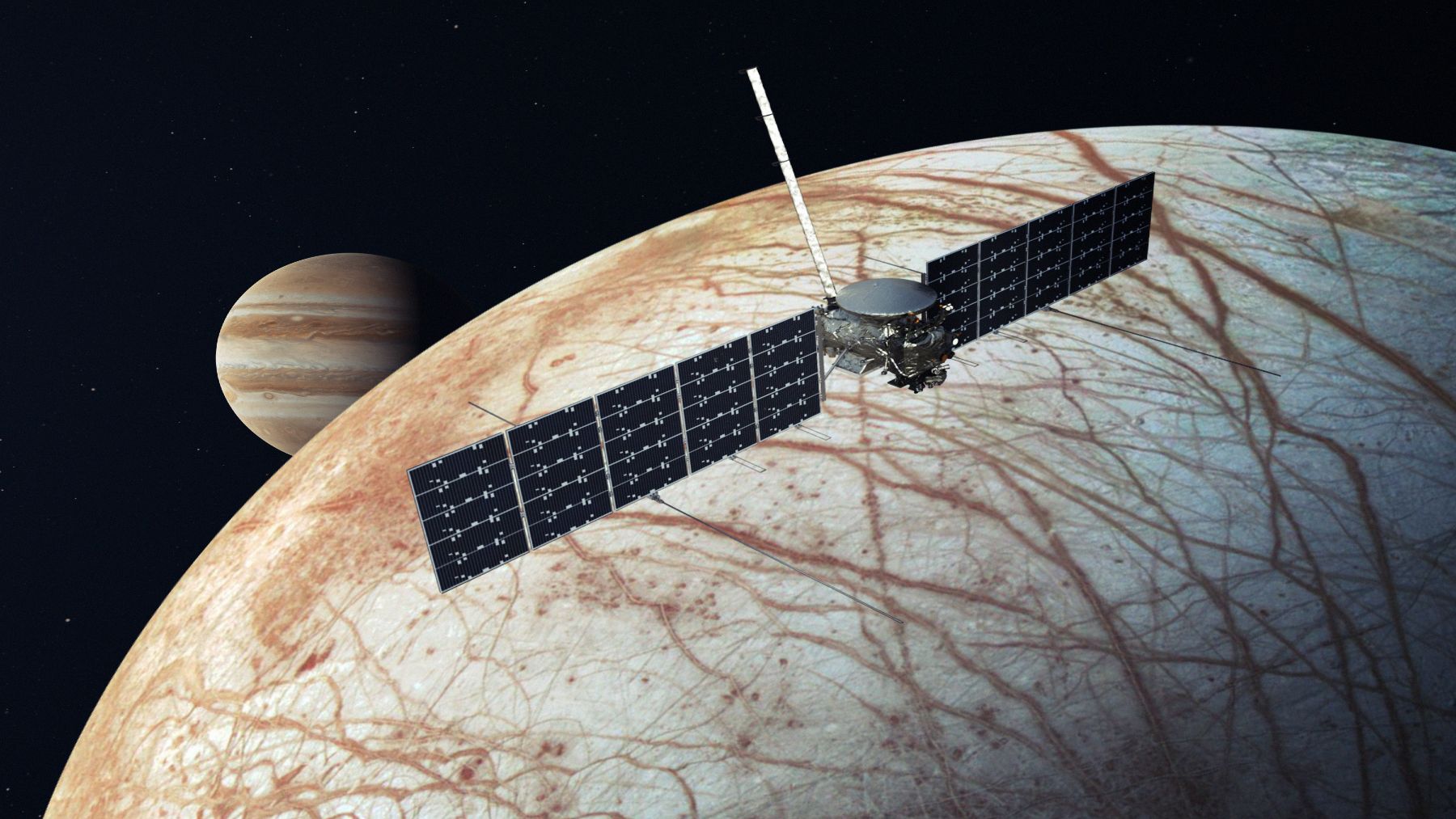
NASA has set off for another grand mission this year through the Europa Clipper space probe. This mission is pioneering and intended to study Europa, one of the least understood moons of Jupiter. This concept has excited humanity for decades, and this mission can help answer the questions that have long eluded our species. As it takes off for a 1.8 billion-mile voyage, Europa Clipper is set to embark on a discovery of this icy moon and its suitability to support life.
Understanding Europa: What makes this moon so intriguing?
Europa is a rather exciting object for astrobiologists. Hiding under its dense icy shell that can be 25 kilometers thick, there is an ocean that could contain more water than all oceans of the Earth. This moon has already excited astronomers as spectroscopic data from NASA’s Galileo mission in the 1990s suggested a salty ocean beneath the Ganymean moon’s surface.
The question that arises now is whether this ocean could contain life. NASA hopes to get the essential information that would allow answering this question with the help of the Europa Clipper. The Europa Clipper carries an impressive set of scientific tools to investigate Europa’s icy crust, a very thin exosphere, and the subsurface ocean.
One of the nine instruments NASA’s lunar orbiter will carry is an ice-penetrating radar that will help define the positions of the lunar surface and areas that may support life. The mission’s design is pretty distinct, with a solar array of 100 ft, showing NASA’s willingness and dedication to embracing innovation in exploration. During the 49 flybys of Europa over several years, the spacecraft will gather data that may revolutionize the view of the distant moon and its ability to host life.
The significance of collaboration: Joining forces for a shared goal
The Europa Clipper mission will be a global project supported by thousands of scientists and engineers. This mission is under the stewardship of NASA’s Jet Propulsion Laboratory in collaboration with other NASA facilities; it is informed by the experiences of Voyager and Juno, among others.
The partnership is considered to investigate Europa and move the knowledge about other ocean planets in the solar system. As Professor Michelle Dougherty of Imperial College London also says, “We are looking for the possibility of life.” Thus, we see that this mission is much more significant for astrobiology.
The quest for alien life: Why this mission matters
The prospect of the scientific exploration of Europa is one of the most exciting potential discoveries ever faced by mankind because the discovery of life beyond our planet could change much more than just the perception of the human race’s place in the universe. If conditions on this moon are found to support life, this will mean that life is not as scarce in the universe as has been estimated.
This could alter how we view the world and prompt more investigation of different galaxies. As Nicky Fox, Associate Administrator of NASA’s Science Mission Directorate, said, “As you venture into the dark, the Europa Clipper will assist in determining whether there exists a chance for living in not only our solar system but also among the billions of moons and planets in the universe revolving round the other suns.
The Europa Clipper mission is not only scientific; it is an exploration of the world and ourselves, of wanting to know there is more out there.
A new era in the quest for life beyond Earth
The next phase in space exploration began with the upcoming Europa Clipper. This is what is in store ahead as New Horizons begins its long journey toward Jupiter: The discovery that awaits is exciting and philosophical. With its sophisticated instruments and collaborative spirit, the mission seeks to answer one of humanity’s oldest questions: Are we alone in the universe?
In the quest to discover other forms of life outside Earth, exploring Europa might be the breakthrough humanity needs to leap the next frontier. According to Jordan Evans, project manager at NASA JPL, “This launch is not just the next chapter of exploration of the solar system, but a step closer to understanding another ocean planet.”
As we await the results of this daring mission, one thing is clear: Knowledge is all the more an unfulfilled entity, and the world has many secrets still locked within it.