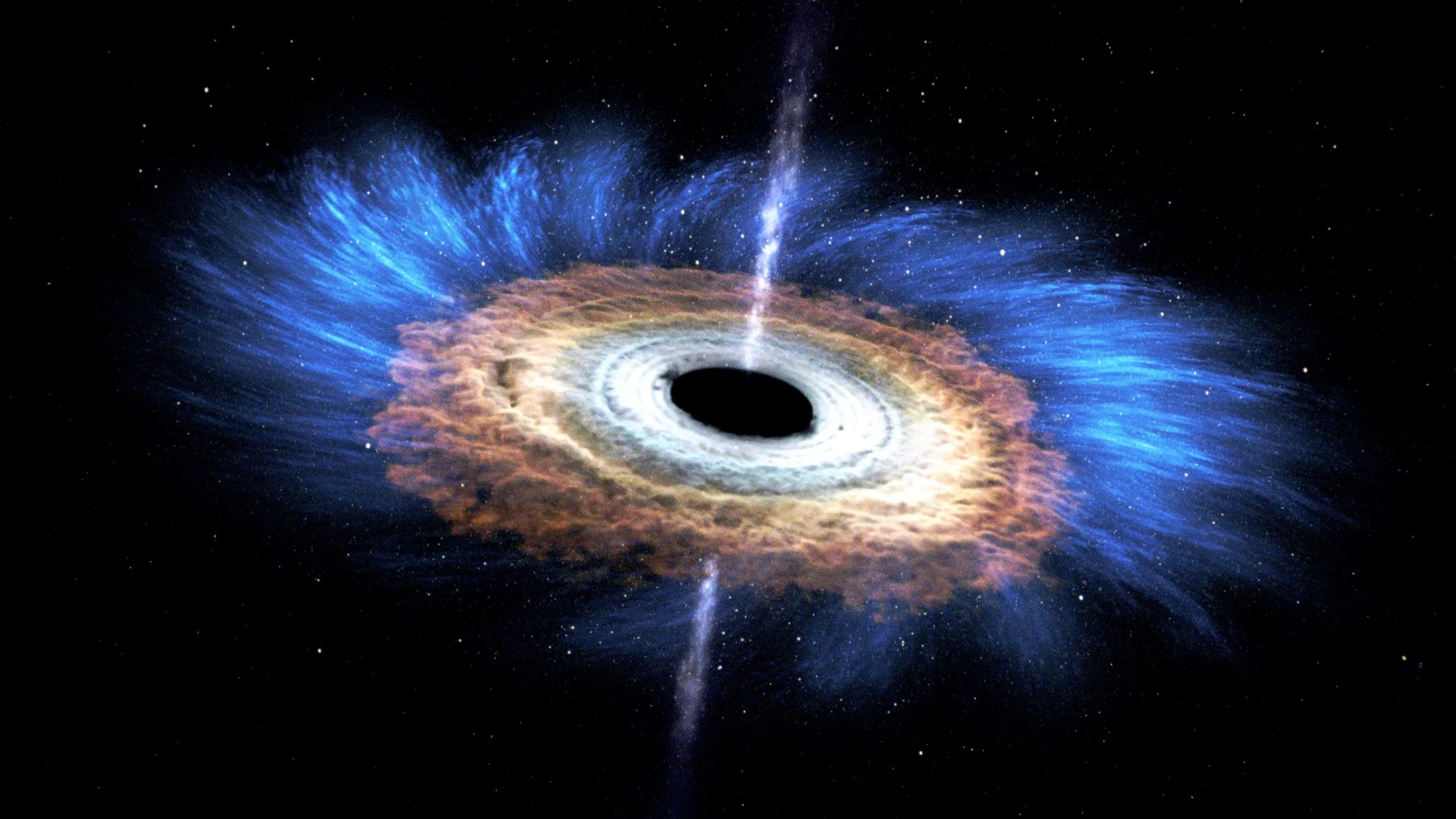
In a groundbreaking achievement, scientists have employed NASA’s Neil Gehrels Swift Observatory to provide evidence of cosmic phenomena that are attended by two enormous black holes. The two supermassive black holes, which are centrically located in a far-off galaxy and are in orbital motion, are causing disturbance of an immense cloud of gas, resulting in a fascinating light pattern that has captured the attention of scientists around the globe.
Explanations for the recurrent events AT 2021hdr have been provided by astronomers
The discovery process, in all honesty, began with a certain event, namely AT 2021hdr which immediately was a quite common astronomical event within supernovae after it was first observed by the Zwicky Transient Facility (ZTF) in California in March 2021.
More outbursts, however, had been detected every 60 to 90 days which suggested something far more bizarre. “It’s a very weird event,” said lead researcher Lorena Hernández-García. “We think that a gas cloud got around the black holes and they cause oscillating patterns of the light from the system due to interference when these black holes disrupt and eat up the gas while rotating.”
The two black holes separated, located in galaxy 2MASX J21240027+3409114 which is a billion light-years away, are about 16 billion miles apart. Together, they contain 40 million times the mass of the sun and orbit in 130 days. They will however collide in the next 70,000 years according to predictions made by the scientist’s efforts, but still, they are not standing idle as their movements cause disturbances in the surrounding gas cloud.
Variations in the intensity of light emanating from a black hole can be correlated with the disturbances in the gas cloud surrounding it
The evidence provided by Swift is essential in analyzing the puzzle. It has been monitoring the binary for UV and X-ray fluctuations and corresponding visible light from ZTF since November 2022. The researchers determined that the results can mainly be attributed to the tidal disruption of a massive cloud of gas.
Due to gravity, the cloud was broken up into smaller pieces forming hot thick gas regions close to the black holes that emit varying light intensity. “Every revolution disposes of gas,” explained Hernández-García, “resulting in light variations at intervals.”
The merging of galaxies provides a new perspective on black hole dynamics
Cloaked in further excitement is the fact that the host galaxy is merging with another galaxy close by, an occurrence that could impact the movement of the black holes. This aspect, which has been revealed for the first time in the study, emphasizes the intricacy of the system and its ability to alter present concepts of galaxy formation.
The episodic eruptions give an insight into the evolutionary cycle of black holes and their surroundings. Such information is valuable in perfecting the theories of black holes and the accompanying galaxy thanks to other activities in the universe.
Twenty years since its launch, NASA’s Swift Observatory remains very relevant in the field of astronomy. “To be honest, it’s amazing to witness all the new science Swift is still helping the community accomplish”, says S. Bradley Cenko, who is the principal investigator for Swift at NASA’s Goddard Space Flight Center.
In the future, Hernández-García is going to pursue more studies of the light curve of AT 2021hdr, both host galaxy and the models of the black holes. This type of research, in addition to, is valuable due to the great mysteries of supermassive black holes, and because it opens the future knowledge of the universe that is in the process of dynamic change.
The finding AT 2021hdr presents intriguing possibilities of how black holes interact with their environments. By understanding more about this aspect, scientists can delve more into the galaxies’ histories, including how black holes evolved over that period. At the same time, the mission continues as the Universe gradually uncovers, and conceals, more secrets, by presenting more exciting and stimulating new aspects of its structure.