Recently, in a galaxy far, far away, about 600 million light-years from Earth, NASA scientists observed an object that shone brightly for weeks, until it simply disappeared. What happened was the appearance of a blue glow on the outskirts of a galaxy. This caught the attention of astronomers; after all, what kind of event was unfolding around the center of a galaxy?
The flash outside the galaxy that caught attention
To find out what this phenomenon was, NASA scientists first relied on the Zwicky Transient Facility telescope, a tool that detects sudden changes in the sky. However, this was not enough, so they turned to the Hubble Space Telescope, which confirmed the phenomenon with high-resolution images. Going deeper into this flash, it is worth mentioning that it already has an astronomical designation: AT2024tvd.
This phenomenon occurred in a peripheral region of a galaxy in the constellation of Hercules and stood out in the sky as an isolated point of ultraviolet blue light, clearly far from the galactic nucleus – about 2,600 parsecs (or 8,476 light-years) away, to be more precise. That is why, right away, scientists noticed that it was not common, but then what caused such intense light in such an unusual place?
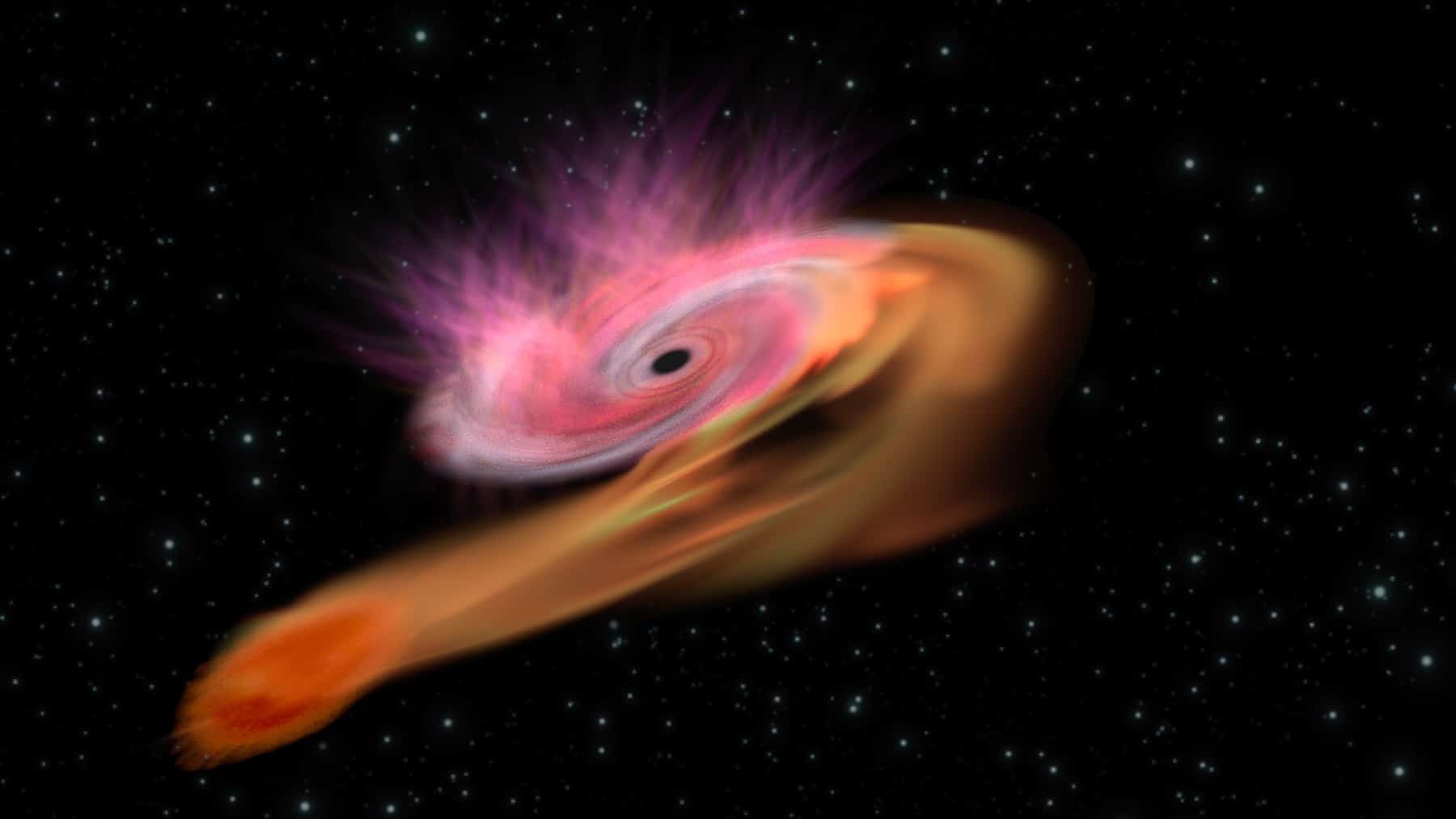
Normally, this type of event is related to supernovae or stellar collisions, however, this glow came from a star. It, in turn, was being torn apart by a supermassive black hole. Yes, it is not a pleasant event; on the contrary, it is an extremely violent process, where intense gravity deforms the star until it has been destroyed.
What is the name of this event?
Yes, even though it is not that common, scientists have already mapped this type of phenomenon and called it a tidal disruption event (TDE). It usually happens when a star gets too close to a black hole and is torn apart by its gravitational force, releasing an absurd amount of light energy. For comparison, it is as if the universe turned on a warning signal visible millions of light years away.
However, what still draws a lot of attention is that all the observed TDEs had been happening in the center of galaxies (like this strange glow right in the center of the galaxy), because that is where black holes usually are. Until AT2024tvd arrived and decided to change things, becoming the first event of this type detected outside the region. And why did this happen, you must be wondering? Well, astronomers have two hypotheses: galactic mergers and interactions between multiple black holes.
- Galactic mergers: When two galaxies merge, their black holes also interact, causing them to be thrown away from the center.
- Interaction between multiple black holes: This is a type of “gravitational push” that can throw a black hole out of the center of the galaxy.
What does this mean for us here on Earth?
What we’re about to talk about may seem confusing, but this discovery could represent a new way for us to map the invisible universe. That’s because black holes are very difficult to detect, especially those that aren’t consuming matter. So when a TDE happens, it acts as a beacon, revealing the presence of that black hole.
According to Ryan Chornock, professor at UC Berkeley:
“These events are very promising for shedding light on the presence of massive black holes that we wouldn’t otherwise be able to detect.”
Well, it seems that AT2024tvd, in addition to confirming the existence of wandering black holes, has opened a new field of research into the dynamics of galaxies. This is essential for us here on Earth, since this galaxy has been showing a mysterious glow, as detected by NASA through the James Webb telescope.