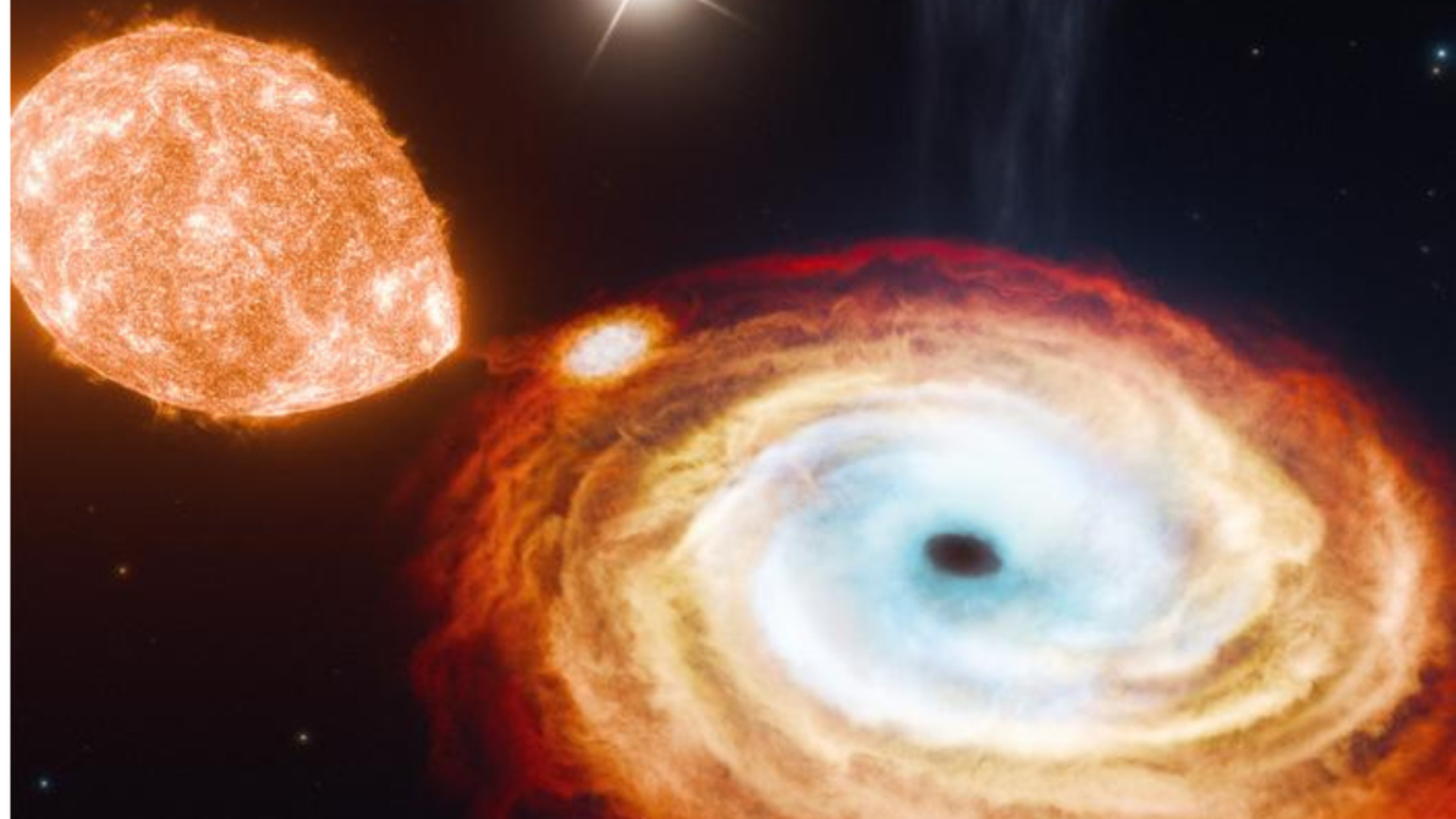
The first-known supermassive black hole responsible for feeding on a Copernican star from a wide binary has been unearthed, a system where all this happens and a third star clingily orbits the energetic environment. Such discovery opens new ways of thinking about black holes evolution and their environment, focusing on perhaps the most intriguing puzzle in modern cosmology.
V404 Cygni: A system of triple stars that alters the view on the formation of black holes
V404 Cygni is an X-ray binary, situated in the Milky Way at 8000 light-years, which features a black hole ripping apart a companion star. The astral binary system was already known, but recent studies by Kevin Burdge, an MIT astronomer, have proven the presence of another, more distant star resided in the orbit around the pair.
This star is particularly interesting because it needs 70,000 years to make one revolution around the pair. This arrangement also provides clues regarding more peaceful processes of black hole formation, such as direct collapse of a massive star.
In this case the outer star would remain alive instead of being expelled by a calamitous supernova event. The type of structure of V404 Cygni provides a different perspective of the formation of black holes which is relatively non-violent.
V404 Cygni: A black hole formed without the help of a supernova explosion?
The death of a gigantic star usually results in the creation of a black hole following a violent outburst called a supernova, which often drives away the surrounding stars. However, V404 Cygni’s stable triple star configuration points towards the formation of its black hole without such a natal kick. The team led by Burdge, however, concluded that this black hole was likely formed due to a non-destructive mechanism called direct collapse, which allowed the other star to remain gravitationally bound.
This evolution of the binary system has a 10-year data hold from the Gaia telescope, in which they verified the circumscribing motion of the third star orbit with a 1 in 10 million odds, that it is pure chance. Burdge compares this tenuous constraint to a kite, stating that, “There is a string that connects the kite and the person holding it. If one pulls too hard, the kite will come off.”
V404 Cygni revealed: A third star brings additional information on the age of the black hole
In addition to revealing the existence of the third star, the research also provided an insight into the age of the system, which is another unusual aspect concerning black holes. This provides evidence that the third star of the system is in the phase of turning into a red giant, which means it has started to leave the burning of hydrogen in its core and is getting larger.
This also led the authors of this study to assess the age of the triple star system as about forty ages 4 billion years ago, which means such age-adjustment has been for the first time ever possible even for a black-hole-related system.
Burdge’s team undertook tens of thousands of simulations of the system’s dynamics. They observed that only those cases which assume no supernova kick agreed with the current state of V404 Cygni, thus corroborating the direct collapse hypothesis.
This finding may promote investigations concerning the frequency of such low-energy black hole formations. In Burdge’s words, “Some black holes do not form via supernovae,” indicating that there could be other evolutionary processes of black holes that we do not know of.
This game-changing finding of a so-called black hole triple system has opened an entirely new chapter in black hole research. The peculiar configuration of V404 Cygni offers crucial clues regarding the formation and stability of black holes suggesting that there could be more triple systems waiting to be discovered. Burdge’s group is now looking into the orbit of the outer companion star as well as searching for more such systems.