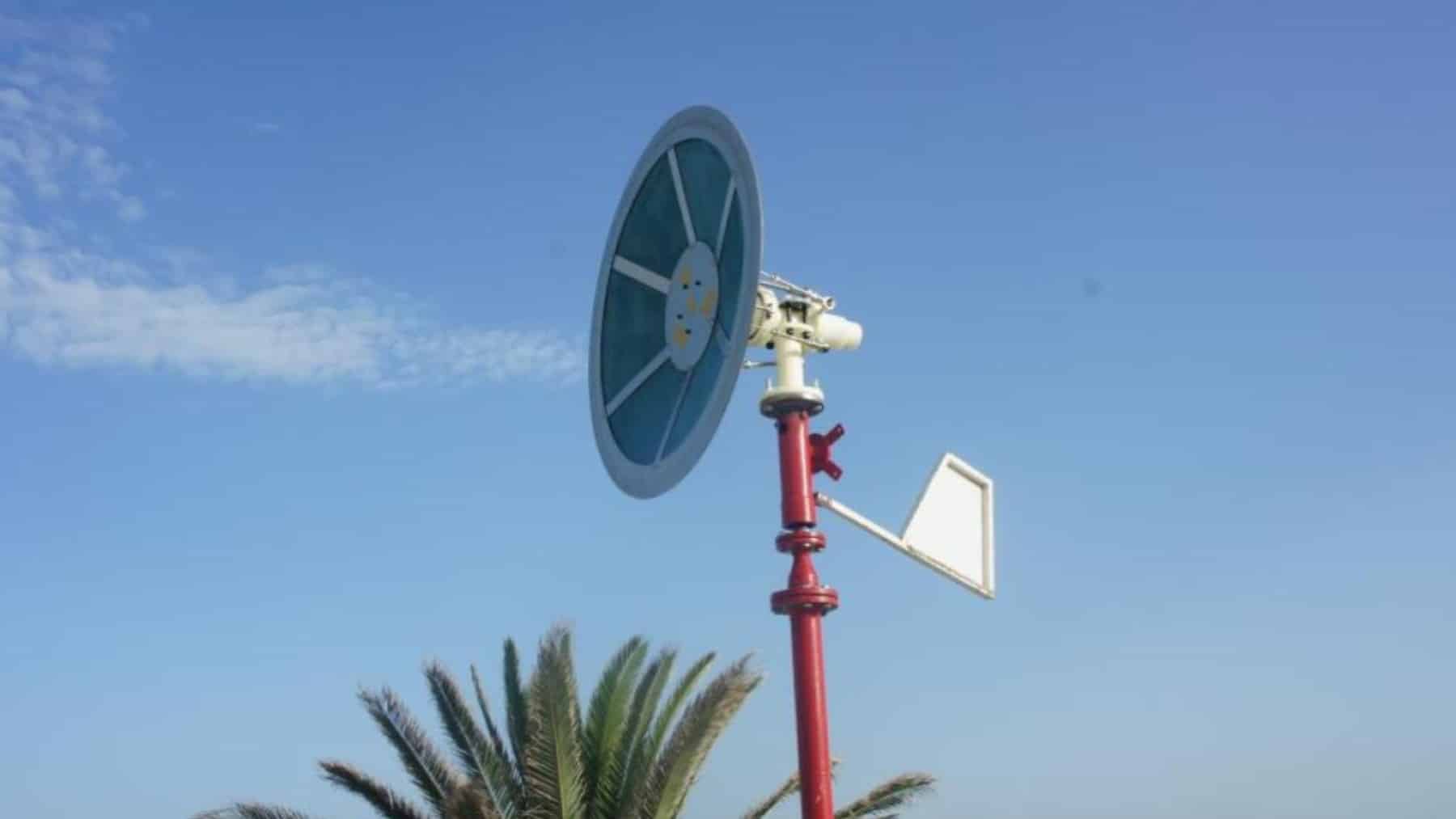
We have a Tunisian startup to thank for introducing us to the Saphonian, which is without blades and gives no problems at all. This Saphonian bladeless wind turbine has gained its place in the spotlight globally, as India is showing interest in exploring new technology for its multi-megawatt project.
Rural communities in India may now have power thanks to India’s plans to create a 50 Saphonian units wind farm, responsible for producing 20 kW of power each. Although the 1 megawatt wind farm is an ambitious plan, India is well on its way to solving the power problem for rural communities.
What makes the Saphonian a unique wind turbine?
The Saphonian does not resemble the traditional wind turbine in any way and looks more like a billowing sail than a turbine. No fiberglass blades are rotating atop a towering mass, but instead, there is a curved dish with sails similar to traditional ship sails. The curved dish with sails does not spin like the conventional turbine, but oscillates back and forth. The focus fell on zero blade technology, and as such, the Saphonian:
- Relies on the wind to push the sails
- The dish’s motion pushes pistons and produces hydraulic pressure
- The pressure spins a hydraulic motor to generate immediate electricity
Since blades have been removed from the equation completely, there is no need for expensive parts, including hubs and gearboxes, which makes turbines expensive. The reason that Saphon Energy created the Saphonian was so that they could produce wind generators at a fraction of the price of other turbines in the same league. With no noise, low costs, and no requirement for rotating blades, this device outweighs all disadvantages.
India is invested in this renewable energy alternative
India is set on the mission of pushing decentralized energy. The country is set on providing energy to rural communities, and is looking at low-cost and low-maintenance solutions. The best solution for the country came in the form of its 1 MW project that is made up of the 50 Saphonian turbines capable of generating 20 kilowatts of power each. With the power generated, remote villages will be catered to.
This renewable energy project is very different from traditional, larger wind farms that demand large towers, cranes, and other complex logistics. India has opted for such a design that is much easier to install, posing no harm to the country’s wildlife population. Adding a simple device made up of a few parts to the renewable energy plans worked out well.
Benefits that go beyond the low cost of the turbine
The turbine that was created in Tunisia has many perks that extend beyond that of costing. Birds are not harmed during the turbine’s operations, and it is a turbine that works rather quietly. The solution remains ideal for areas that are rather densely populated, or even areas where wildlife roams freely.
A bonus of opting for this energy-generating alternative is that hydraulic energy storage is built into the turbine. This feature is rather useful for microgrids, as energy is stored as pressurized liquid. Some critics are not quite as enthusiastic about this type of turbine’s potential. They feel that the numbers on paper cannot capture the turbine’s true potential; nevertheless, India seems content with their chosen solution. The country is considering this solution and is looking beneath the surface, searching for a discovery that could rewrite history.
From a village-scale pilot project to beyond
While still in the early stages, should this village-scale pilot project work out for the country, it could result in widespread deployment, particularly in regions where other conventional turbines won’t be able to work. We have Tunisia to thank for its turbine concept that came from Mediterranean sailing traditions for this new energy agenda. Not only is India relying on the wind, but the country is also harvesting power from the air with a specific device.