News from the James Webb Space Telescope amazed astronomers, astrophysicists, and members of the public. A peculiar galaxy arrangement captured by a telescope displayed a strange question mark galaxy appearance for astronomers to contemplate. This article investigates this futuristic discovery, starting from how scientists explain this phenomenon and what it reveals about space exploration.
The space phenomenon mirrors a question mark in size.
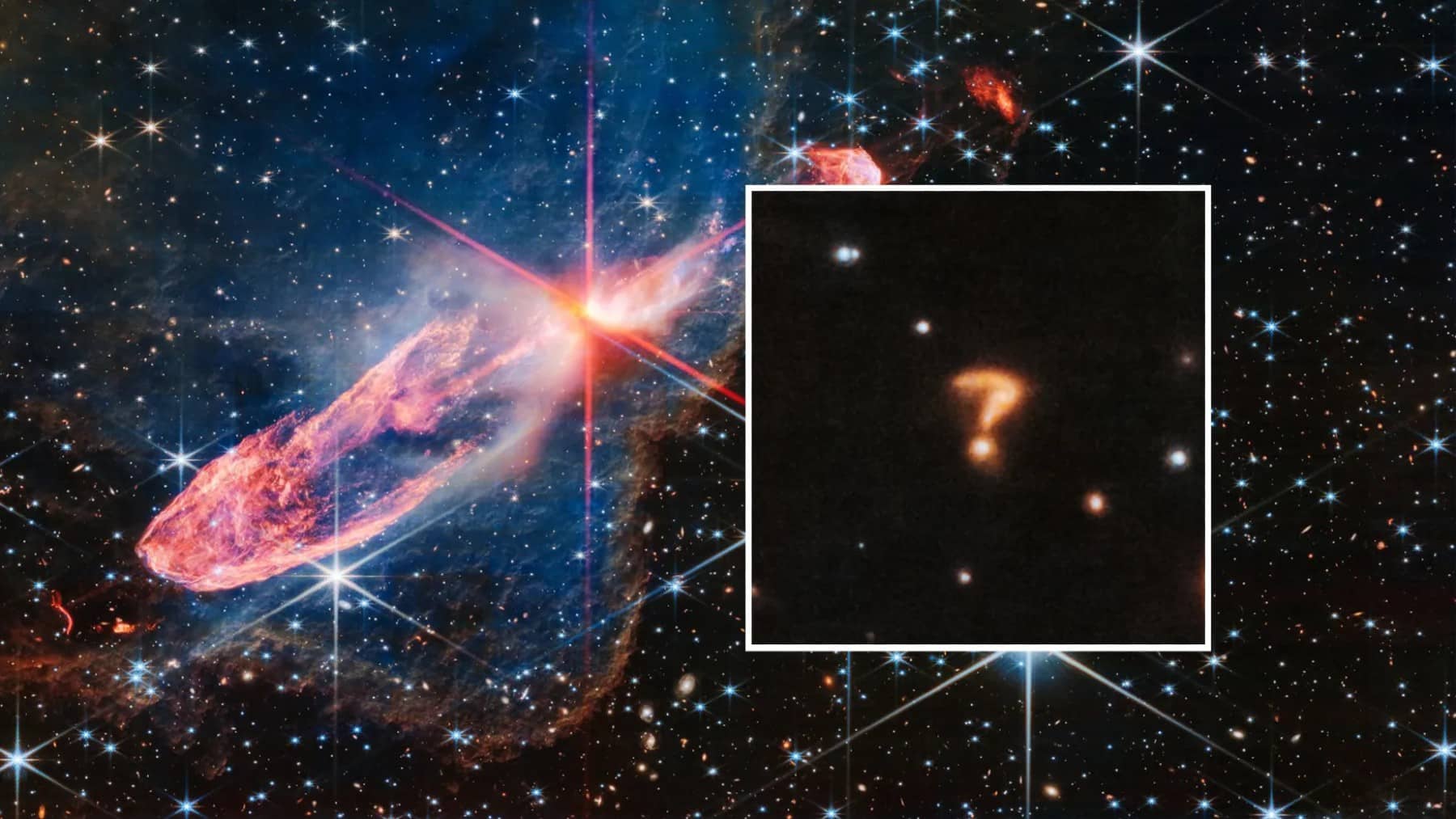
The James Webb Space Telescope recorded a historical deep space image, revealing a space formation that looked like a question mark. The unusual geometric structure results from an extraordinary cosmic configuration that nature did not create. John McCleary from Northeastern University describes the gravitational lensing theory as explaining space-time effects through galaxy cluster mass warps, which alter travelling light waves in space-time.
A cosmic magnifier operates through gravitational lensing because space objects become distorted, and their light grows more intense as they pass through the lens. The question mark appearance results from how distant galaxy lights warp each other through space-time. The blue clusters at the upper portion form a double image of the same galaxy because the lensing effect has duplicated it. The red shape forming the body of the question mark originates from a different galaxy, and an unrelated distant galaxy happened to be precisely situated below it when the photo was taken.
The universe bends light in ways you won’t believe.
Astrophysics scientists can examine distant objects through gravitational lensing since the technique strengthens faint objects beyond human visibility. The passage of distant galaxy light near massive clusters such as galaxy clusters causes gravitational bending that produces duplicate images of the original galaxy. The gravitational effect distorts galaxy appearance simultaneously with image magnification, which allows scientists to conduct enhanced studies.
According to McCleary, the strange question mark formation results from the way space-time distorts. Our perspective on Earth from Earth produces the question mark appearance, but the galaxies maintain their natural shapes. The exceptional positional arrangement creates an excellent condition for investigating galaxy evolutionary patterns utilizing detailed observational data.
This telescope just captured a glimpse of the universe’s wild teenage years.
The Webb telescope has revealed this unfathomably ancient universe moment, which describes its “adolescence” phase. Approximately 7 billion years ago, the universe underwent rapid star formation while galaxies were assembled. Billions of years of space travel brought the image to Earth, which shows the universe as it appeared during its initial developmental stage.
According to McCleary, the universe experienced a rapid expansion during this time, including rapid star formation and exponential galaxy building. Scientists can now study such cosmic processes because the Webb telescope reveals previously impossible-to-study details. Scientists use gravitational lensing images and their enlarged versions to develop better knowledge about galaxy creation while learning about their evolutionary patterns.
How this cosmic mystery could change what we know about galaxies
The question mark galaxy discovery impacts the scientific field of astrophysics in major ways. The James Webb Space Telescope demonstrates its remarkable power through its ability to study space using gravitational lensing as an important tool. The high-quality space telescope imagery delivers essential information which supports scientists’ search for basic knowledge about galaxy features and galaxy-developing processes.
Scientific researchers want to understand how galaxies transform from the original matter before the universe ages. Although research into the subject has been ongoing for centuries, many essential aspects remain unknown. Scientists believe the question mark galaxy can observe galaxy formation, leading to discoveries about this mysterious process.
The question mark galaxy discovery underscores the modern astronomy advancements which stem from the exceptional capabilities of the James Webb Space Telescope. The question mark galaxy allows scientists to view universe history while providing unparalleled prospects for scientific exploration. Our space exploration will discover progressively more exceptional phenomena which push our factual understanding toward new boundaries and keep our curiosity alive.