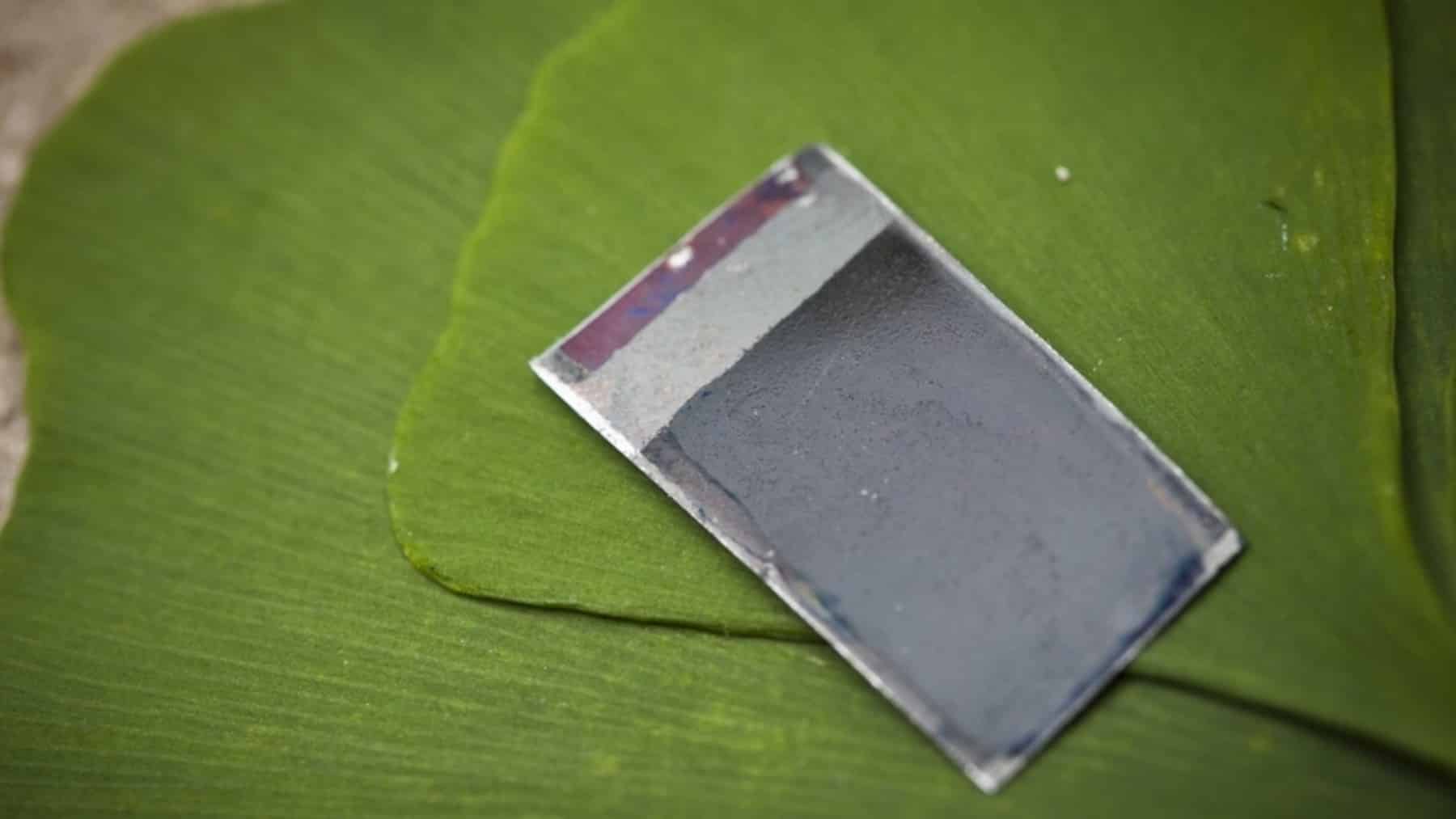
With the world focusing on clean energy, a record-breaking solar panel is set to push the boundaries of what solar panels can do. A “PV-leaf” was created by scientists at Imperial College London is somewhat of a hybrid solar device that takes inspiration from nature itself. As opposed to other traditional flat solar panels, the leaf-shaped panel is able to capture more sunlight and purify water as it generates thermal energy. Lab tests show that this futuristic innovation is showing serious potential in lab tests and overperforming other technological panels by over 13%.
How the PV leaf uses transpiration as a principle?
Traditional photovoltaic (PV) panels are able to absorb 24.5% of the sunlight that it gains; however, a significant portion of the sun’s energy is lost as heat. When solar panels warm up, their efficiency drops even further. Experimental panels pushed efficiency closer to 33%, but only under certain conditions at a high cost. The real challenge has been cooling the panels without consuming more energy or adding complex machinery.
The PV-leaf borrows from nature’s playbook and uses the concept of transpiration which is the same method that plants use to stay cool. Trees are able to move water from their roots up to their leaves, releasing it through pores to regulate temperature. Similarly to trees, the PV-leaf system is able to utilize stacked hydrogel cells and bamboo fibers to draw water from a tank to the solar surface passively. An easy design can dissipate up to 75% of solar-induced heat without any pumps, electricity, or fans. This results in a solar panel that is able to stay cooler and works better for longer.
Solar panels able to produce water and heat
Like the first white solar panel that does more than just generates power, the PV-leaf system does not stop at cooling and introduces new tricks to the world of clean energy. During testing, researchers used saline water in the cooling process and found that the resulting vapor could be condensed into drinkable freshwater. This is a good opportunity for remote communities, off-grid housing, and arid regions that are struggling with a water scarcity problem.
The condensation process results in low-grade thermal energy. While not powerful enough to run a power plant, it’s well-suited for everyday applications like domestic space heating or preheating water. The researchers call this a “synergistic” design that doesn’t simply convert sunlight to electricity but also makes use of the heat and water that are involved in the process. This multipurpose system has enormous implications for sustainable living.
The PV-leaf’s design is able to contribute to its efficiency. The shape of the leaf enables maximum surface exposure similar to that of a real leaf stretching toward the sun. According to lab tests installed and tested under real-world conditions, the PV-leaf shows boosted performance over traditional solar panels.
Could the PV-leaf be in your backyard soon?
Prior to imagining your home boasting these artificial leaves, it is important to note that the PV-leaf is still in development. Although the lab results are promising, the system hasn’t been adapted into a commercial format. Recent prototypes are still bulky and optimized more for testing than production. However, researchers are optimistic, predicting that with the right engineering adjustments, the PV-leaf could become a commercial product.
This solar concept seems to be pushing boundaries in the right direction. Unlike other traditional panels, this future solar panel shows that energy solutions can be smarter, cleaner, and inspired by the natural world.
The PV-leaf could soon be part of homes, schools and cities reminding citizens that sometimes the most advanced innovation looks like something we’ve seen all along, a leaf soaking up the sun. Perhaps these leaf solar panels could even be better than blue, green and turquoise first ever multicolored panels.