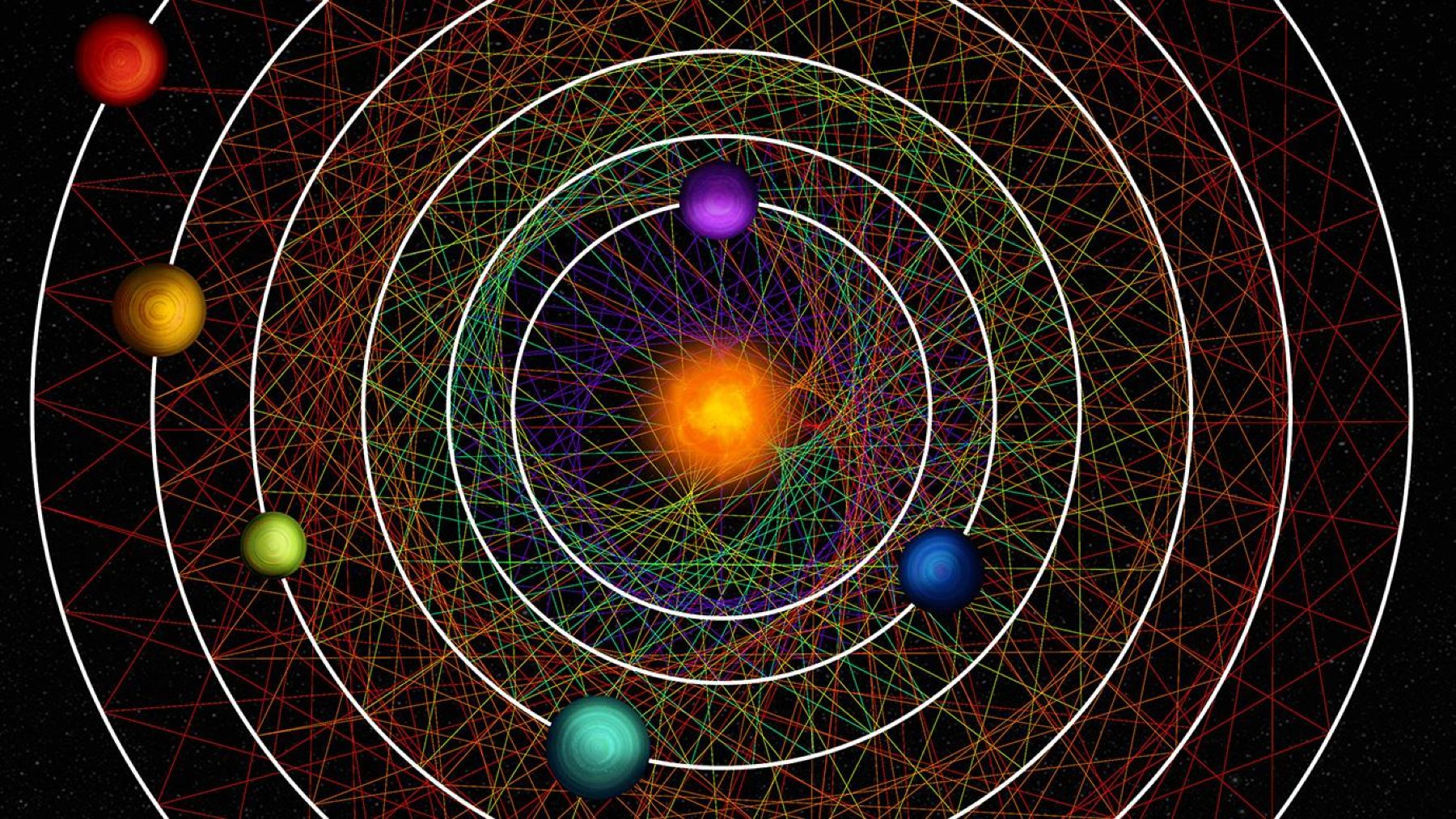
In the constellation Coma Berenices, 100 light-years away from the earth, there lies a heliospheric marvel – the planetary system HD110067. While most planetary systems have chaotic dances, this planetary system is remarkably melodious, having six exoplanets orbiting their host star in precise mathematical resonance. Such a stable configuration opens new avenues toward understanding the planetary formation and evolution processes-an astronomical rarity.
Planetary system HD110067: A balance of billion years, quite fossil like
It turned out to be an amazing discovery at HD110067-a stable system showing orbital resonance where the planetary orbits are pinned in consistent ratios to allow the planets to run after each other at intervals. Researchers discovered the movement of these planets to follow a pattern dubbed 3:2 or 4:3-in that every three completions of a planetary orbit bring two completions of the other’s path.
Such movement implies that this balance in orbit must be close to the original setting of conditions around a billion years earlier. Scientists predicted and confirmed the existence of six planets in HD110067 with the help of TESS and CHEOPS telescopes from NASA and ESA, respectively.
According to their findings, there are interesting rhythms: while this innermost planet revolves six times, the outer one revolves only once. Such resonation remains a very rare reminder of the original form a planetary system might have preserved, like finding a fossil in space.
The system tends to suggest that it has a unique formation history. Most planetary systems bear scars of migration from giant planets or disruption by close stars, but HD110067 seems to have avoided such chaos. Its resonant chain most probably formed early and remained intact, presenting an unprecedented opportunity in planetary arrangement studies free from the perspective of man.
Scouring the world for the prospect of extraterrestrial life in hot Sub-Neptune planets
The possibility of life brings with it an additional dimension of interest. Although they are sub-Neptune planets-hot worlds-with temperatures over 200°C, one or more of them could be within a temperate zone suitable for liquid water.
Those conditions make this system quite promising for future research. Scientists suspect that even the most extreme of environments could sustain microbial life or distinct chemical processes, which would enlarge our definition of habitability.
Astrophysicists such as Carmen Choza at the SETI Institute, have examined the existence of alien technology within HD110067. Scanning radio signals or technosignatures using data from the Green Bank Telescope, the team aimed to find evidence of intelligent life.
No results were found, after the first search; however, the stability and configuration of the system still promise in defining future sensitive explorations. The techno signatures search in systems like HD110067 introduces the concept of planetary science in the search for extraterrestrial intelligence. Such systems are particularly interesting for such searches because their resonances may allow conservation of energy and fine conditions for the development of advanced civilizations.
Discovering the secrets of planetary system evolution through HD110067
The HD110067 system is not only a scientific curiosity but also a critical key to understanding the whole universe. It is understood that a planetary system is born in resonance but later, its balance is disturbed due to collisions, the birth of giant planets, or interactions from its nearby stars.
The HD110067 is probably a snapshot of at a time when systems were at their smoothest. It raises further questions regarding our own solar system. Since here sub-Neptunes are absent, whereas they seem widely established elsewhere, one might wonder what it is about our solar system that makes it different.
Insights from HD110067 could help explain how to model the evolution of planetary systems. So, the orbital configuration of the system could show how planets are interacting with their own protoplanetary disk while forming. This will help to reconstruct how planetary systems will evolve over billions of years.
The HD110067 system is a diamond in the rough: its perfect resonance suggests planetary dynamics and stability over cosmic timescales. Advanced tools like the James Webb Space Telescope will fully reveal the atmospheric compositions and chemical signatures, significantly deepening our understanding of these distant worlds.