While current focuses of alternative engine solutions are clustered around talks of climate, engines which can travel through space have not been neglected by some. Space travel has significantly advanced in the past 100 years and it is only getting better. Innovations from private companies like SpaceX and Blue Origin have made significant impacts as well as continued research from NASA. One such recent advancement which has fascinated scientists is establishing how one would travel through wormholes.
Wormholes: A gateway to alternative galaxies
A wormhole is a hypothetical tunnel-like structure in spacetime that connects two separate points in the universe. The concept arises from the equations of general relativity, suggesting that if such structures exist, they could allow for shortcuts between distant regions of space and time. Essentially, a wormhole would create a bridge, enabling travel between far-flung locations almost instantaneously, potentially facilitating faster-than-light travel.
While wormholes are a fascinating idea in theoretical physics and popular science fiction, there is currently no experimental evidence to confirm their existence, and numerous challenges, such as stability and traversability, remain largely speculative. However, this has not stopped scientists from speculating on how traveling through these hypothetical portholes could work.
A fractal engine to travel through space
Fractal wormholes are a particular hypothetical variation of wormholes. Fractal wormholes can be imagined to be a network of interconnected wormholes that exhibit fractal properties, potentially allowing for more complex routes through spacetime. While these types of wormholes also purely exist in the hypothetical and make use of complex geometric principals and patterns, that has not stopped researchers from developing hypothetical solutions to how to travel through a fractal wormhole should one exist.
Traveling through these types of wormholes utilizes the principles of the McGinty equation Ψ(x,t) = ΨQFT(x,t) + ΨFractal(x,t,D,m,q,s), where the variables in ΨFractal(x,t,D,m,q,s) are manipulated to create a stable wormhole of a specific size and duration. This complex equation is a new scientific theory that combines traditional Quantum Field Theory with fractal geometry to solve quantum mechanical problems.
The equation is a novel approach and is not recognized widely by mainstream mathematics and physics. Nevertheless, it showcases robust innovation and creative thinking when considering how one could possibly travel from one end of the galaxy to another. It is mathematically valid and highlights the underlying beauty of physics. While often siloed to be either experimental or theoretical, investigative research like this highlights how theoretical concepts can be used to solve complex problems and propose new hypotheticals about the universe.
How a fractal engine would work
The engine has been proposed by Chris McGinity, creator of the McGinity equation. He describes how in order for the engine to work, a stable environment within the wormhole would have to be created.
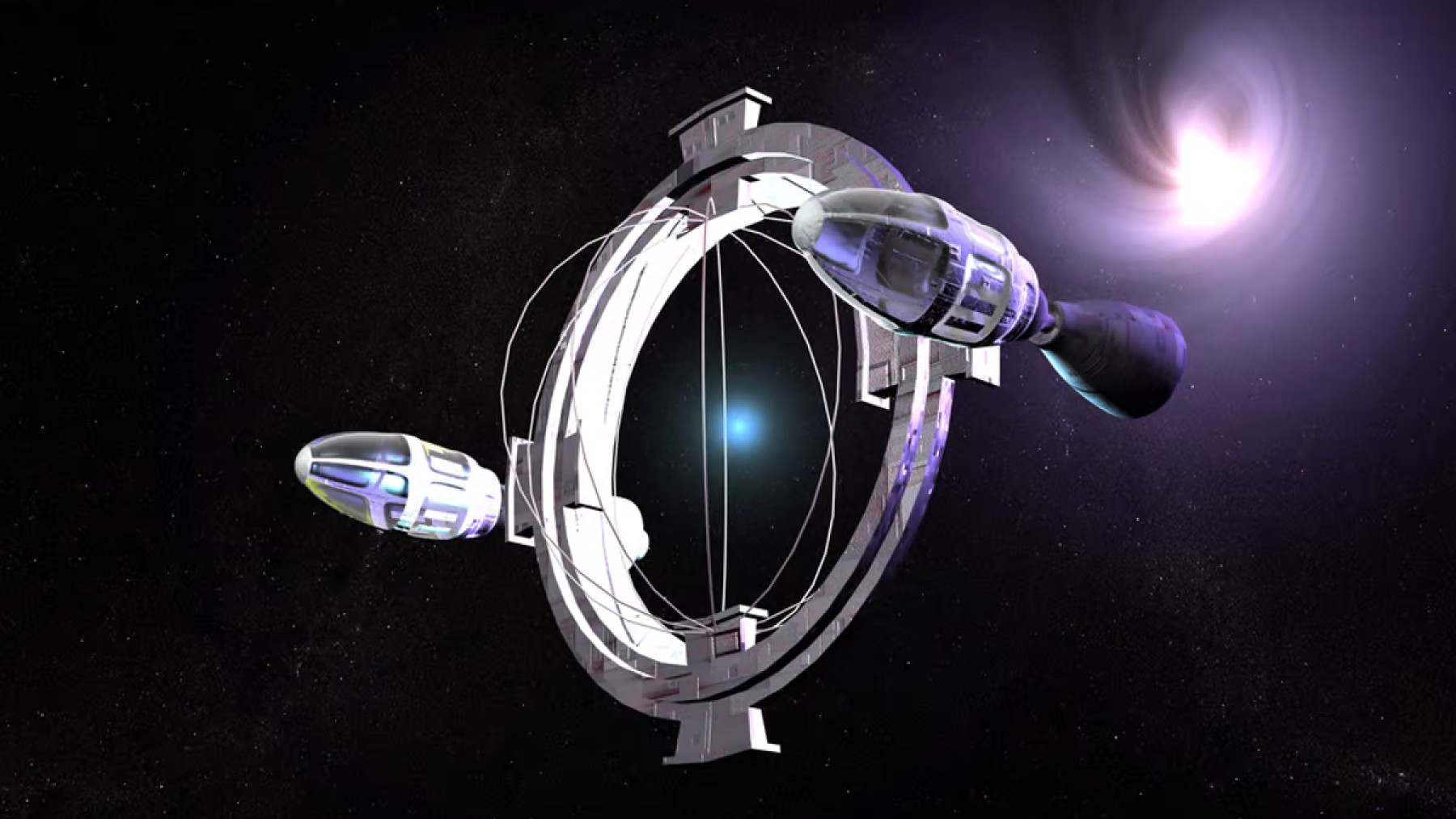
“Once the stable wormhole is created, a spacecraft equipped with the fractal engine would enter the wormhole, and traverse it at speeds that exceed the speed of light,” describes McGinity in his LinkedIn post titled A fractal propulsion engine will control and navigate wormholes, allowing an object to traverse them at faster-than-light speed, “The fractal engine would work by manipulating the properties of space-time within the wormhole, allowing the spacecraft to travel through it at faster-than-light speeds”.
“The fractal engine would require a significant amount of energy to create and maintain the stable wormhole, as well as to power the spacecraft’s propulsion system,” continued McGinity, “scientists would need to develop new, highly advanced forms of energy production and storage to make the fractal engine a practical reality”.
Theoretical physics is a fascinating realm, and hypothetical ideas of traveling through different galaxies may very soon not be the stuff of science fiction but an actual reality.