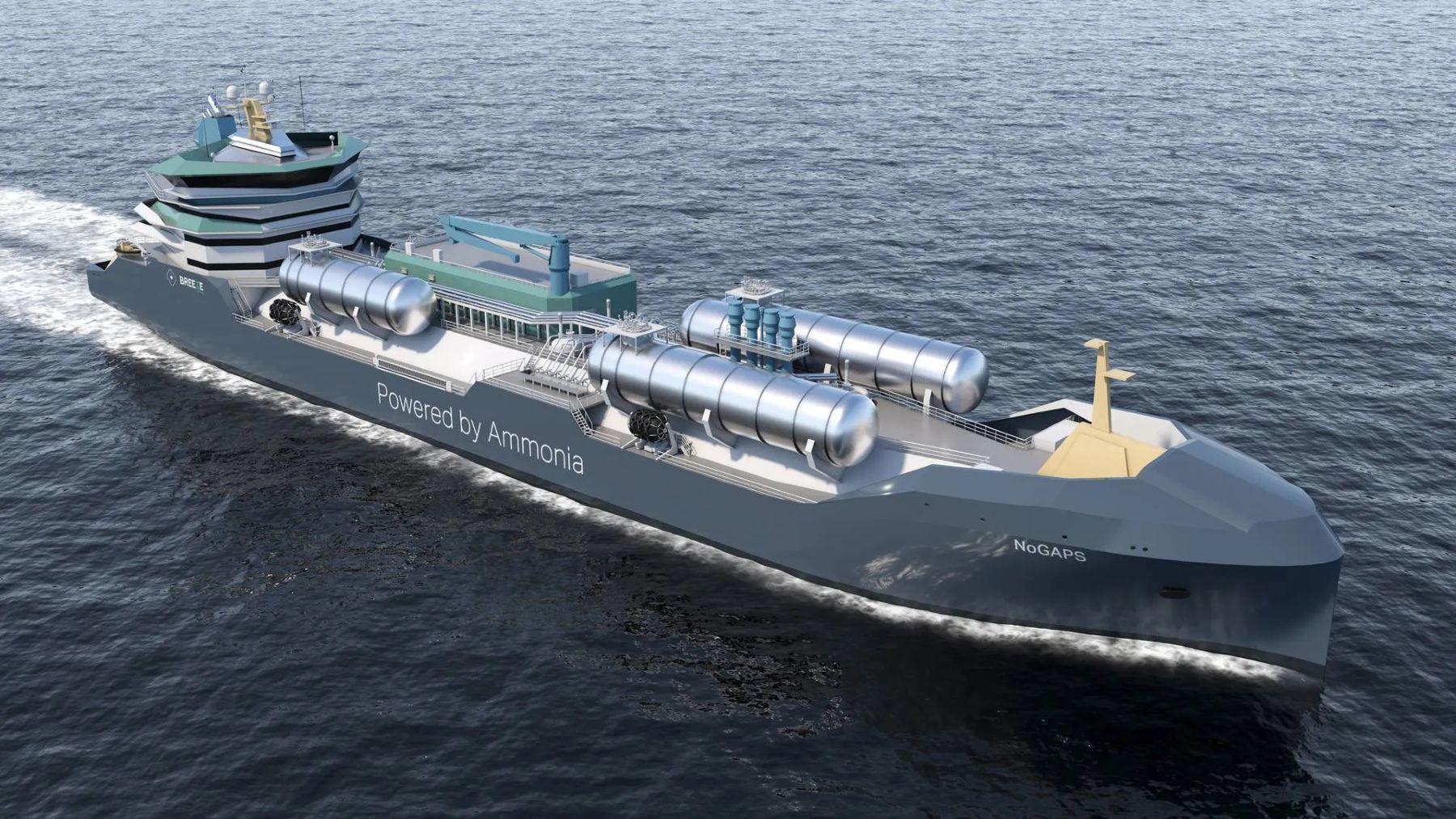
At the moment, it is relevant to the maritime industry to move to carbon-free shipping, and further ongoing work is being done to seek more effective techniques in lessening its share of climate change. The first company that seemed to follow this line of thought is a British-based Windship Technology, which unveiled what it has called the ‘Tesla of the seas’ fairly recently.
Despite Windship Technology initially relying on wind power as the dominant type of propulsion, it then moved to ammonia as the marine fuel, which sparked interest among major players and raised questions about the safety of such a fuel as well as its efficiency. In particular, the above-discussed reorientation of LNG as a fuel for VLCCs has raised questions within the industry about the feasibility of ammonia as a sustainable marine fuel and possible difficulties in its implementation.
Windship Technology’s Futuristic Design: Zero Emissions and Solar Arrays Combined
For Windship Technology, the design incorporates a triple wing rig alongside a diesel-electric ship drive, which will eventually mean the ship will be capable of emitting zero CO2, NOx, SOx, and particulate matter. The design of the vessel, which is also futuristic, contains large solar arrays, carbon capture technology, optimized shapes of the hulls, and specialized software for routing the weather.
This windship is one of the most significant research highlights; it exhibits a Windship Technology rig with a height of 48 meters which folds on deck making it easy to navigate through ports and handle cargo. The firm asserts that this offers the “only realistic and least expensive zero-emission solution for ocean-going bulk carrier ships and oil tankers.
Ammonia as a Marine Fuel: Exploring the Risks and Rewards of this New Energy Source
It thus shifts focus to the use of liquid ammonia as the marine fuel. Although Windship Technology planned to use wind energy in the main it focuses now on the utilization of ammonia as a marine fuel. This decision explains why the industry is giving attention to ammonia as one of the ways through which decarbonization could be achieved.
Ammonia refers to the compound made up of nitrogen and hydrogen, which has gained increased recognition as a future promising carrier for emissions slashing. However, using ammonia as a fuel also poses threats of toxicity and threats arising from risks, which would require safe measures for handling ammonia.
Industry Partnerships for Ammonia Technology: Certification and Collaboration for a Greener Future
However, Windship Technology has collaborated with other industry players to expand into ammonia-powered shipping. A prominent example of such a partnership is the WtI with DNV GL. This major classification society has recently supported Windship Technology in acquiring the new building and will be responsible for verifying the ship’s design.
Moreover, a Korean one which includes the classification society Korean Register, shipbuilder Hanwha Ocean, aerospace and industrial company Hanwha Aerospace, and ammonia power solutions firm Amogy have agreed on a memorandum of understanding (MoU) that will focus on a technical and certification partnership for ammonia reformers and ammonia fuel cell system for application in ships.
These partnerships are additionally an attempt to guarantee the questionability of the ammonia-based systems that are continually tried, certified, and recognized according to universal conventions and norms.
The Future of Maritime Fuel: Will Ammonia Revolutionize the Industry?
Hailed as the ‘Tesla of the Seas,’ the Windship Technology motivates the segment towards the renewal of a cleaner and greener maritime industry. The company claims ammonia is the primary marine fuel, which is also one of the most emerging markets available. Nonetheless, the successful implementation of this technology requires significant proofing, certification, and assessment of the potential hazards incurred with the actual use and storage of ammonia.
Therefore, doubts persist about the ability of the shipping industry to change to low-carbon sources and find ways of overcoming the general endogenous issues in the industry in the adoption of new and possibly risky fuel types. In the future, appropriate linkages of manufacturers involved in the design and construction of ships, the owners, the regulatory bodies, and other shipping industry stakeholders will be central in turning the industry into a low-carbon sector while maintaining the right levels of safety and efficiency of operations.