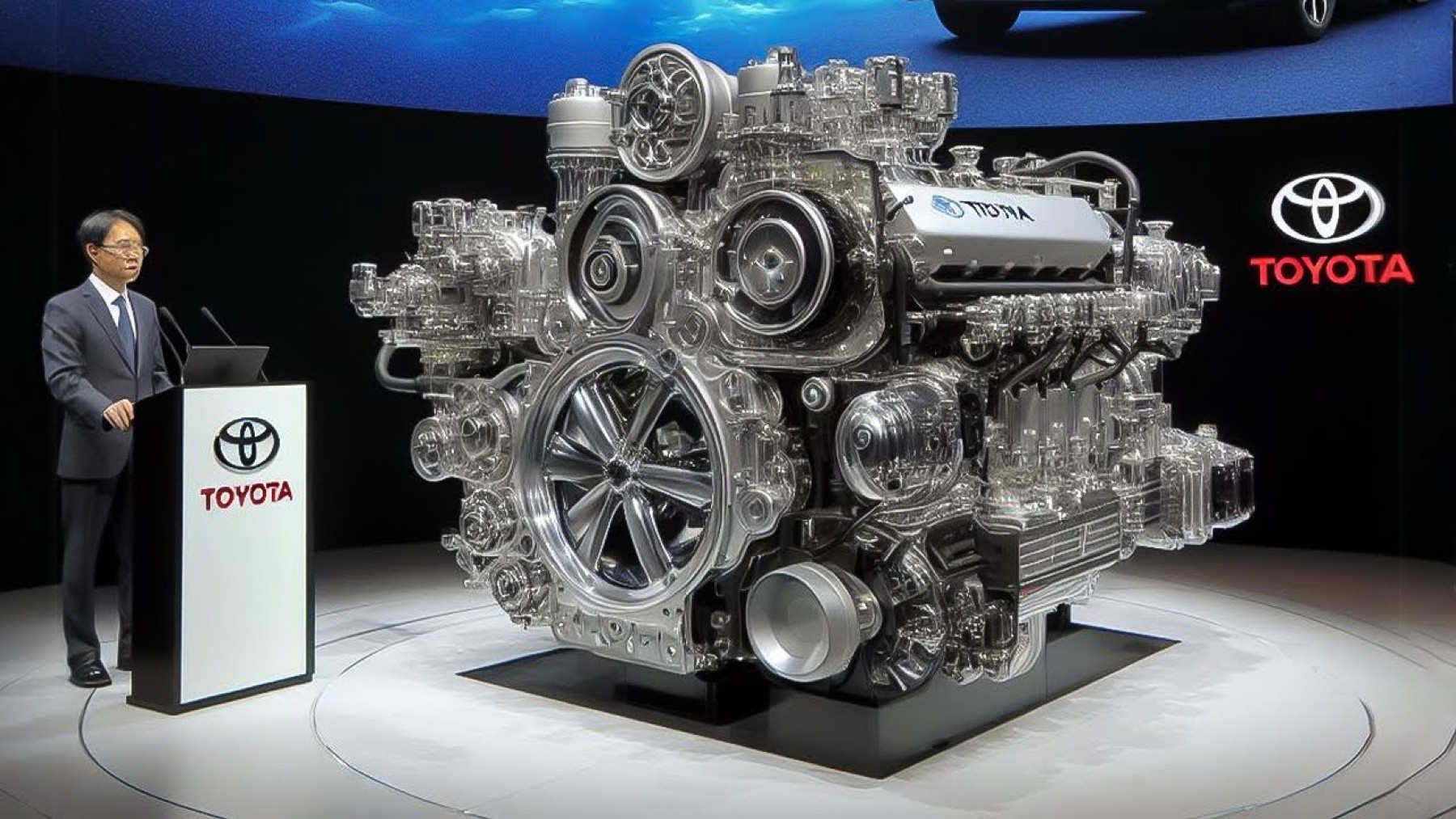
In a groundbreaking move that has stunned the automotive world, Toyota has revealed its latest experiment: the Corolla Cross Hydrogen Concept. This car reforms the conventional burning system of automobiles and experiments with automobile engineering.
At first glance, it might appear as if this hydrogen combustion engine is of no use or completely illogical. Still, it is a daring leap into a future of no emissions and might revolutionize how we approach energy and transport.
Hydrogen combustion engine: A bold step toward a zero-emissions future
While the auto industry has been fixated on electric vehicles for years, Toyota has a new idea with its hydrogen combustion technology. The Corolla Cross Hydrogen Concept is an essential step towards achieving the goal of making cars carbon neutral.
Hydrogen combustion can be the solution that will take less time to be implemented than fully electric vehicles, especially in areas with no charging infrastructure. Toyota is not giving up on battery-electric vehicles but is expanding its portfolio of zero-emission technologies, including hydrogen combustion, to meet global demands better.
This move is supported by years of development, with lessons learned from motorsport – Toyota’s hydrogen-electric GR Corolla has been trialed in the brutal Super Taikyu endurance series. Toyota engineers are keen to refine this technology and provide an option that could be employed everywhere, from race circuits to city streets.
The company has always used motorsport as a proving ground for new technologies, and the hydrogen combustion engine is no exception. In 2022, Toyota will unveil the hydrogen-powered GR Corolla in Japan’s Super Taikyu endurance races.
These high-intensity events stretched the capabilities of the combustion of the hydrogen engine to the limit and reaped handsome benefits. The car’s performance saw significant improvements by the end of the season: The new models have 24% more power, 33% more torque, and 30% greater range.
These increases show that hydrogen combustion is as effective as traditional gasoline engines in performance and efficiency and still supports the vision of a clean future.
More important is the speed at which these advances were made possible, as indicated in the following section. In these motorsport trials, development has been advanced in a way that would not be reachable in regular road-car testing.
The Corolla Cross Hydrogen Concept stems directly from this intense motorsport application while proving the practicality of a hydrogen-powered combustion engine.
Hydrogen combustion engine: Faster refueling and lower costs than battery-electric alternatives
Hydrogen combustion has benefits for Toyota, as explained in this paper. Another significant advantage is that it can build on existing ICE technologies, making it more credible, feasible, and less costly than the other alternatives in today’s vehicle models.
Refueling hydrogen combustion engines is also quicker than recharging battery electric vehicles, which is still a significant advantage in emerging charging networks.
What Toyota envisions is not just a technical possibility but a global possibility, a possibility for everyone. Hydrogen combustion engines may offer a carbon emissions reduction answer that is more common and does not rely as heavily on scarce metals such as lithium and nickel, which are both essential for battery manufacturing.
For Toyota, hydrogen means that people can carry on using the familiar combustion engines, but cleanly and sustainably. In the future, Toyota’s strategy for popularizing hydrogen as an alternative energy source is obvious.
Therefore, the company’s long-term vision is a complex process of becoming carbon neutral in several ways to meet the needs of various customers worldwide. This also includes ongoing advancements in the hydrogen fuel cell technology applied in vehicles such as the Toyota Mirai, not to mention the hydrogen combustion engines.
The ultimate goal is, therefore, to have multiple zero-emission technologies to accommodate the different infrastructure and customer preferences worldwide.
Within this process, Toyota is also investigating the feasibility of using liquid hydrogen, as the transition from the liquid hydrogen-powered GR Corolla shows.
As tanks are made more advanced and pumps are made to last, hydrogen has a promising future in motorsports and beyond. Thus, linking hydrogen burning with other ZEV technologies, Toyota plans to set the trend for the automotive industry in the context of sustainable development.
Hydrogen combustion engines: A visionary move toward clean and sustainable transportation
Some might find the notion of a hydrogen combustion engine unadulterated fiction, but Toyota’s advances are not fantasies. The Corolla Cross Hydrogen Concept and the developments in motorsport show that hydrogen combustion engines are not just a future but a potent reality.
As Toyota progresses with the evaluation of this technology, it has the potential to lead to the emergence of the next generation of environmentally friendly, high-performance automobiles. It is not a crazy idea; it’s an insight into the future of green mobility.