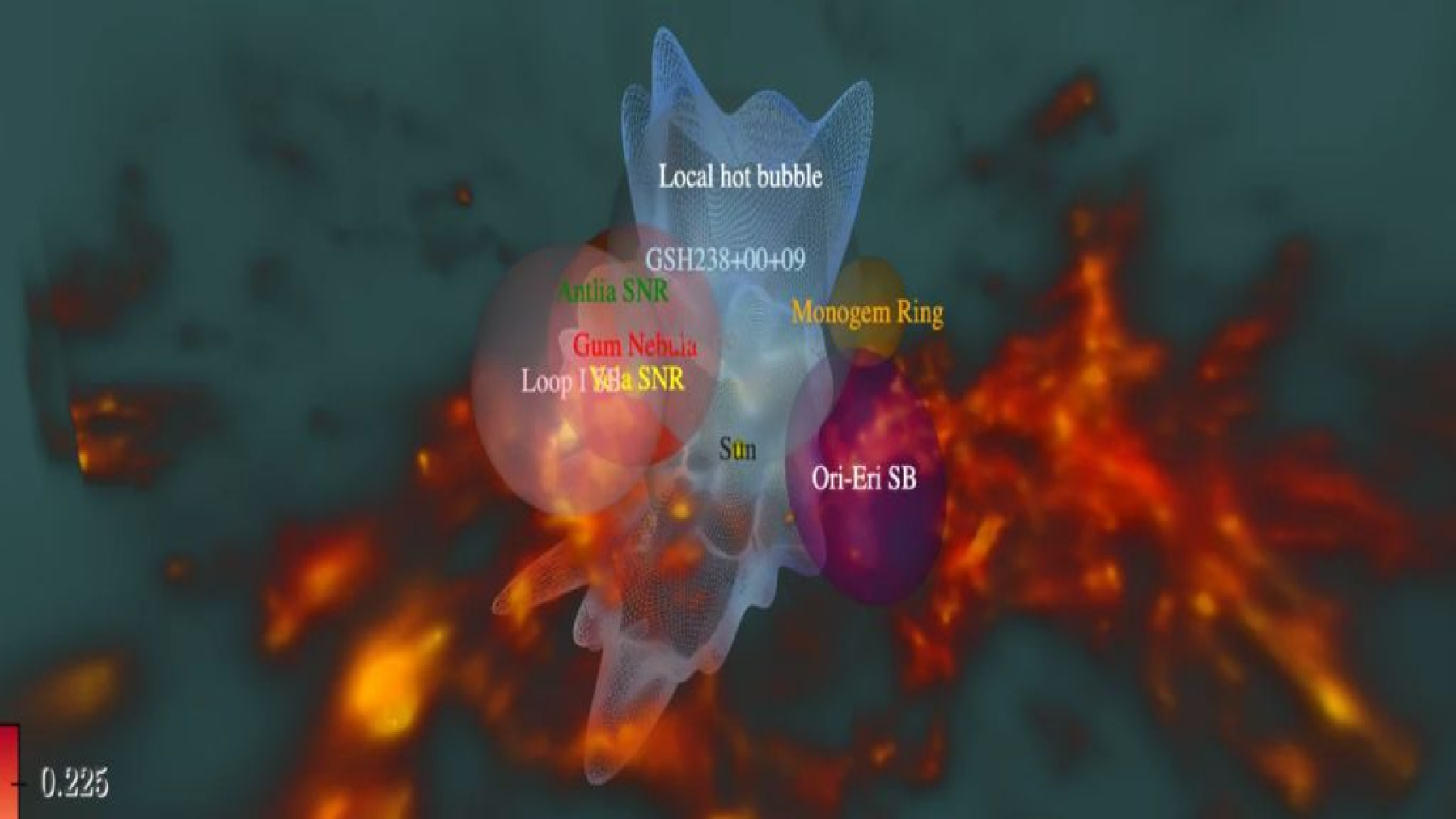
Apart from all that, the universe is interesting as it is, and the recent finding of an ’interstellar highway’ within the Local Hot Bubble (LHB) is even more intriguing. This is a region of space that is hot and low in density and spans over 1,000 light-years where our solar system is situated. Using X-ray telescopes, the oasis’ characteristics and its relationship with other oases as well as its importance in the Milky Way galaxy have been studied.
The remnants of a supernova: Where does the local hot bubble come from?
The Local Hot Bubble’s narrative traces back to a period of about 14 million years ago when multiple supernova occurrences took place. These destructive stellar phenomena removed any underlining interstellar matter forming a huge cavity with very hot gases of close to a million Kelvin temperature.
The Local Hot Bubble, unlike other star forming regions, is mostly devoid of matters, thus making it possible for the X-ray radiations to leak out and be observed by the astronomers. The eROSITA telescope has recently validated those unusual structures of the given bubble. Being over 1.5 million kilometers away from the blue planet, the shielding techniques used in eROSITA are advanced enough to minimize any distortions that may occur due to the planet’s atmosphere.
Consequently, the sharpness obtainable for such images is almost the best that can be achieved. Studies have provided a bubble map outlining the shape and heat variation patterns of the bubble supporting its asymmetric shape and temperature fluctuations in the wonder enabling to agree with the supernova hypothesis.
Centaurus tunnel: A querzy gateway within the Milky Way
Some works have made mention of a bizarre structure which is in the direction of the Centaurus constellation. This region, which has been defined to be a hole in the distribution of the cooler interstellar medium, has fascinated scientists for some time now.
The tunnel might extend from the low-density bubble of the LHB to another similar bubble, or even be part of a larger intergalactic network within the Milky Way. The idea of hot bubbles and tunnels being connected within the interstellar medium, proposed in 1974, finds more support thanks to these results.
It may also serve to establish the existence of previous supernova activity and its scope within the processes of millions of years contained in the structure of the galaxy. However, the specific location to which the Centaurus tunnel leads is unknown, it is however associated with the Gum Nebula and other molecular clouds found in the vicinity, suggesting several connections on a larger cosmic scale.
Diving deep into the Universe: The expansion of the local hot bubble with intensity and in its radial direction
The LHB, on the other hand, cannot be viewed as merely fortuitous. The painstaking 3D diagram of the researchers projects the bubble formed to be growing along the axis which is perpendicular to the plane of the galaxy so that less resistance is encountered when growing in vertical directions.
This expansion and the asymmetry of temperature indicate that a few million years ago, there were several supernova explosions that re-heated and re-shaped the bubble in question. The possibility of an interconnected system of bubbles and tunnels engulfing the Milky Way is provoking enough to warrant rethinking the processes of galactic evolution.
Such structures are thought to be the result of the energy dispersed by stars and their existence could facilitate the expanse of matter and energy in the galaxy. This interconnected structure would also have consequences on the process of star formation with respect to the formation of young stars situated at the edges of the bubble.
The Local Hot Bubble, as well as the curious interstellar tunnel, show how our galaxy is highly interconnected. The advent of tools such as eROSITA allows astronomers to explore more of the cosmic neighbourhood, such as in the case of the eponymous telescope, to create a bigger picture of the history of the Milky Way. But as more time passes, such discoveries are bound to increase understanding of the active and complex structure of the galaxy.